8-Hydroxy-2-quinolinecarboxaldehyde → HCID 178515865, compound
Reaction equation
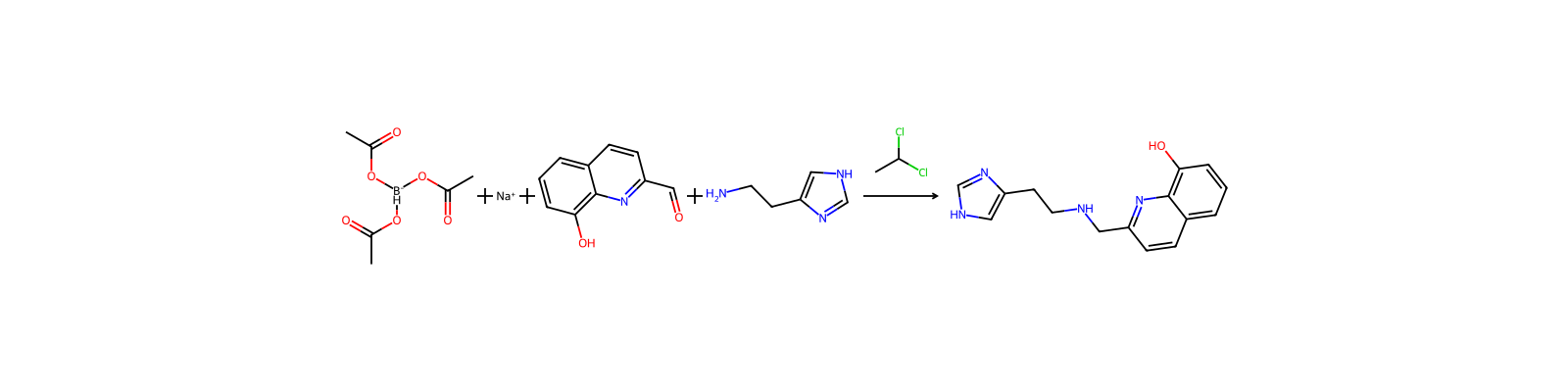
C(O[BH-](OC(=O)C)OC(=O)C)(=O)C.[Na+].[OH:15][C:16]1[CH:17]=[CH:18][CH:19]=[C:20]2[C:25]=1[N:24]=[C:23]([CH:26]=O)[CH:22]=[CH:21]2.[NH2:28][CH2:29][CH2:30][C:31]1[N:35]=[CH:34][NH:33][CH:32]=1>ClC(Cl)C>[NH:33]1[CH:32]=[C:31]([CH2:30][CH2:29][NH:28][CH2:26][C:23]2[CH:22]=[CH:21][C:20]3[C:25](=[C:16]([OH:15])[CH:17]=[CH:18][CH:19]=3)[N:24]=2)[N:35]=[CH:34]1Participants
5





Procedure
Sodium triacetoxyborohydride (225 mg, 1.061 mmol) was added to a stirred solution of 8-hydroxy-quinoline-2-carboxaldehyde 4 (200 mg, 1.156 mmol) and histamine (128 mg, 1.152 mmol) in dichloroethane (10 mL). The mixture was left to stir at RT for 16 h, neutralized (aqueous NaHCO3), and concentrated. The resulting residue, after column chromatography on silica (ethyl acetate/i-PrOH/2 N NH4OH, 6:2:1), afforded 2-{[2-(1H-imidazol-4-yl)-ethylamino]-methyl}-quinolin-8-ol F1 as a straw-colored solid (190 mg, 61%). The above method was repeated using other amines: 2-(aminomethyl)pyridine gave F2 and 2-(2-methylaminoethyl)pyridine gave F3, data given in Table 2.
Workup
- waitThe mixture was left
- concentrationneutralized (aqueous NaHCO3), and concentrated
Sources & evidence
- ORD record
- ord-7dd0b87464a648748717035f74ddb67f
- Source dataset
- uspto-grants-2015_10
- Patent number
- US09169211B2
Reaction notes
Loading…