5-Chloroisatoic anhydride → 9-Chloroindolo[2,1-b]quinazoline-6,12-dione
Reaction equation
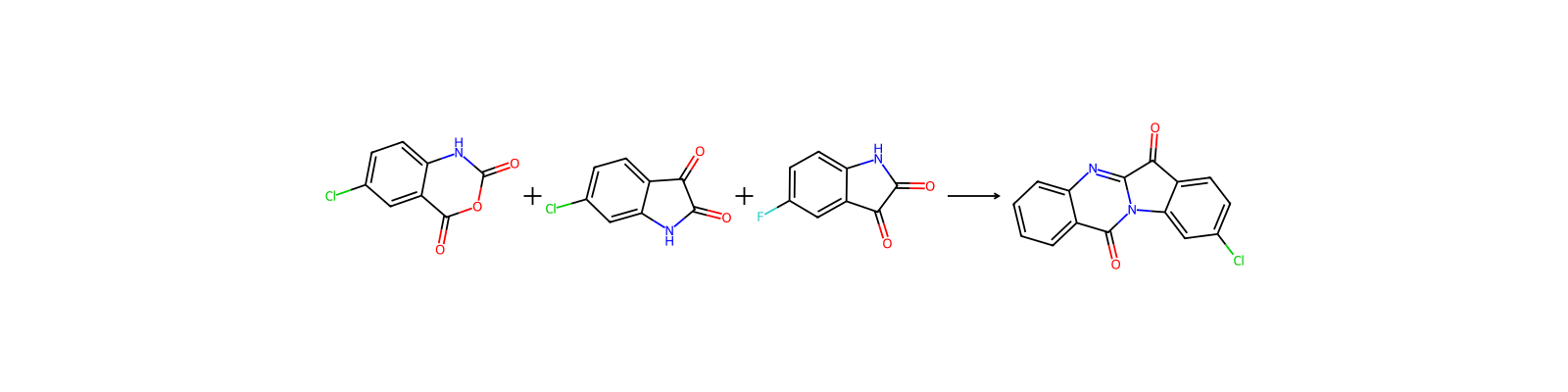
Cl[C:2]1[CH:13]=[C:6]2[C:7](OC(=O)[NH:11][C:5]2=[CH:4][CH:3]=1)=[O:8].[Cl:14][C:15]1[CH:23]=[C:22]2[C:18]([C:19](=[O:25])[C:20](=O)[NH:21]2)=[CH:17][CH:16]=1.FC1C=C2C(=CC=1)NC(=O)C2=O>>[Cl:14][C:15]1[CH:23]=[C:22]2[C:18]([C:19](=[O:25])[C:20]3[N:21]2[C:7](=[O:8])[C:6]2[C:5](=[CH:4][CH:3]=[CH:2][CH:13]=2)[N:11]=3)=[CH:17][CH:16]=1Participants
4


Procedure
Using the procedure in Example 12 and substituting isatoic anhydride for 5-chloroisatoic anhydride and 6-chloroisatin for 5-fluoroisatin gave the title compound in 14% yield: mp 300.6°-303.1° C.; 1H NMR (300 MHz, DMSO-d6) δ 8.49 (d, 1H) 8.35 (d, 1H) 7.89 (d, 2H) 7.94 (d, 1H) 7.72-7.82 (m, 1H) 7.55-7.62 (m, 1H); MS (M+CH4CN)+ 324.
Sources & evidence
- ORD record
- ord-0515f78be70a4edaa896548edcd7e5b8
- Source dataset
- uspto-grants-1995_08
- Patent number
- US05441955
Reaction notes
Loading…