Acetonitrile → 4-(2-Pyridylmethyl)-2-dodecyl-2H-tetrazole
Reaction equation
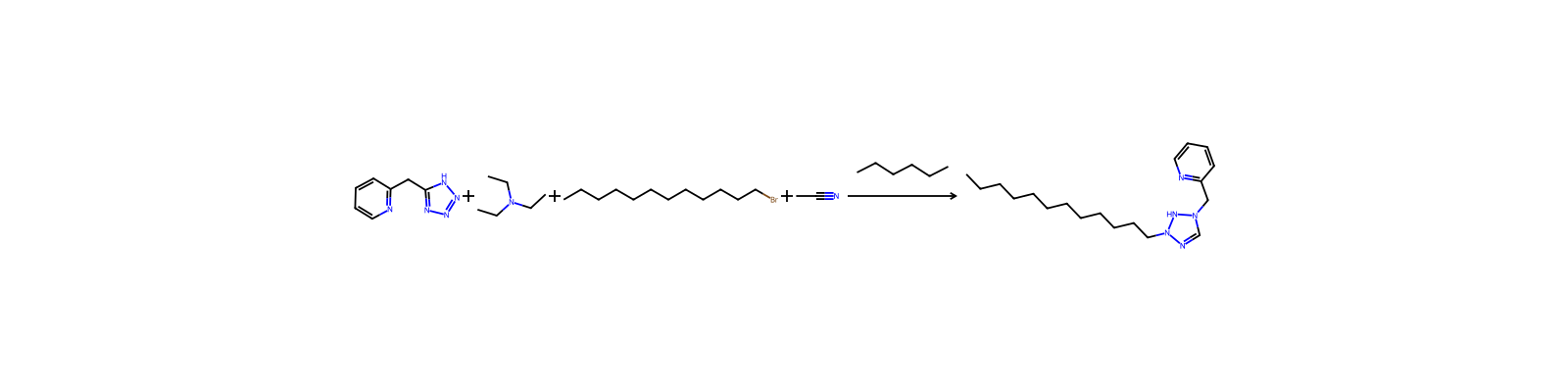
N1C=CC=CC=1C[C:8]1[NH:12][N:11]=[N:10][N:9]=1.C([N:15]([CH2:18][CH3:19])[CH2:16][CH3:17])C.Br[CH2:21][CH2:22][CH2:23][CH2:24][CH2:25][CH2:26][CH2:27][CH2:28][CH2:29][CH2:30][CH2:31][CH3:32].[C:33](#N)[CH3:34]>CCCCCC>[N:15]1[CH:16]=[CH:17][CH:34]=[CH:33][C:18]=1[CH2:19][N:9]1[CH:8]=[N:12][N:11]([CH2:21][CH2:22][CH2:23][CH2:24][CH2:25][CH2:26][CH2:27][CH2:28][CH2:29][CH2:30][CH2:31][CH3:32])[NH:10]1Participants
6
Reactant 4




Product 1

Reagents, catalysts & solvents 1

Procedure
The tetrazole (a) (3.0 g; 0. 015 moles) was taken up in acetonitrile (50 mL) containing two equivalents of triethylamine (3.0 g; 0.030 moles). The suspension was heated to reflux and then treated with 1-bromododecane (3.7 g; 0.015 moles) dropwise for several minutes. The solution was refluxed for 16 hours, cooled to room temperature, and the solvent removed in vacuo. The residue was triturated with ethyl acetate, filtered, and concentration of the filtrate in vacuo leaving a maroon-colored liquid. The 2-isomer was obtained by dissolving the crude product in 50% hexane/50% ethyl acetate and removing the impurities, including the 1-regioisomer, by silica gel chromatography. Yield: 2.0 g (41%).
Workup
- temperatureThe suspension was heated
- temperatureto reflux
- temperatureThe solution was refluxed for 16 hours
- customthe solvent removed in vacuo
- customThe residue was triturated with ethyl acetate
- filtrationfiltered
- customconcentration of the filtrate in vacuo leaving a maroon-colored liquid
- customThe 2-isomer was obtained
- customremoving the impurities
Sources & evidence
- ORD record
- ord-ca87683a93f24f3e9232d005637bcdab
- Source dataset
- uspto-grants-1995_08
- Patent number
- US05441975
Reaction notes
Loading…