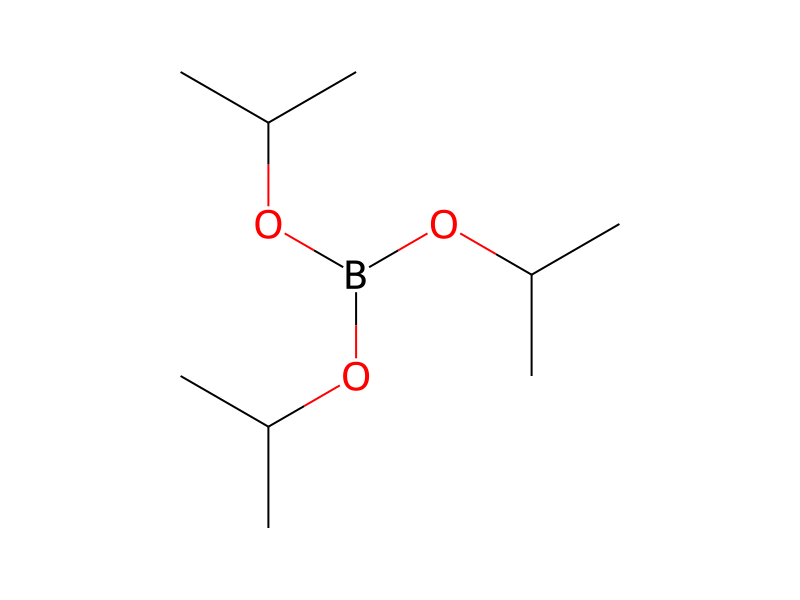
Triisopropyl borate → 2-Octyloxy-5-pyridineboronic acid
Reaction equation

[CH2:1]([O:9][C:10]1[CH:15]=[CH:14][C:13](Br)=[CH:12][N:11]=1)[CH2:2][CH2:3][CH2:4][CH2:5][CH2:6][CH2:7][CH3:8].C([Li])CCC.C([O:25][B:26](OC(C)C)[O:27]C(C)C)(C)C>C(OCC)C.CCCCCC>[CH2:1]([O:9][C:10]1[N:11]=[CH:12][C:13]([B:26]([OH:27])[OH:25])=[CH:14][CH:15]=1)[CH2:2][CH2:3][CH2:4][CH2:5][CH2:6][CH2:7][CH3:8]Participants
Reactant 3


Product 1

Reagents, catalysts & solvents 2


Conditions
- Temperature
- -75 °C
Procedure
2.75 g (10 mmol) of 2-octyloxy-5-bromopyridine are dissolved in 60 ml of absolute diethyl ether, and the solution is cooled to -75° C. under inert gas. 16 mmol of 1.6M butyllithium solution in hexane are added, and the mixture is additionally stirred at -75° C. for 15 minutes. 4.5 g of triisopropylborate in 50 ml of absolute diethyl ether are then added dropwise. The cooling device is then removed. After the batch has warmed to room temperature, 50 ml of 10% HCl are added, and the mixture is additionally stirred at room temperature for 30 minutes. The phases are separated, and the organic phase is washed twice with saturated NaCl solution. The solvent is distilled off in vacuo, and the residue is recrystallized from acetonitrile, giving 6-octyloxypyridine-3-boronic acid.
Workup
- customThe cooling device is then removed
- temperatureAfter the batch has warmed to room temperature
- addition50 ml of 10% HCl are added
- stirringthe mixture is additionally stirred at room temperature for 30 minutes
- customThe phases are separated
- washthe organic phase is washed twice with saturated NaCl solution
- distillationThe solvent is distilled off in vacuo
- customthe residue is recrystallized from acetonitrile
Sources & evidence
- ORD record
- ord-7291f1ffde824df6887bf39092a43130
- Source dataset
- uspto-grants-1995_08
- Patent number
- US05443754
Reaction notes
Loading…