Cyanuric chloride → 2,4-dichloro-6-(2,4,6-trimethylphenoxy)-1,3,5-triazine
Reaction equation

[N:1]1[C:8](Cl)=[N:7][C:5]([Cl:6])=[N:4][C:2]=1[Cl:3].[C:10]1([CH3:19])[CH:15]=[C:14]([CH3:16])[CH:13]=[C:12]([CH3:17])[C:11]=1[OH:18]>C1(C)C=CC=CC=1>[Cl:3][C:2]1[N:4]=[C:5]([Cl:6])[N:7]=[C:8]([O:18][C:11]2[C:12]([CH3:17])=[CH:13][C:14]([CH3:16])=[CH:15][C:10]=2[CH3:19])[N:1]=1Participants
4
Reactant 2
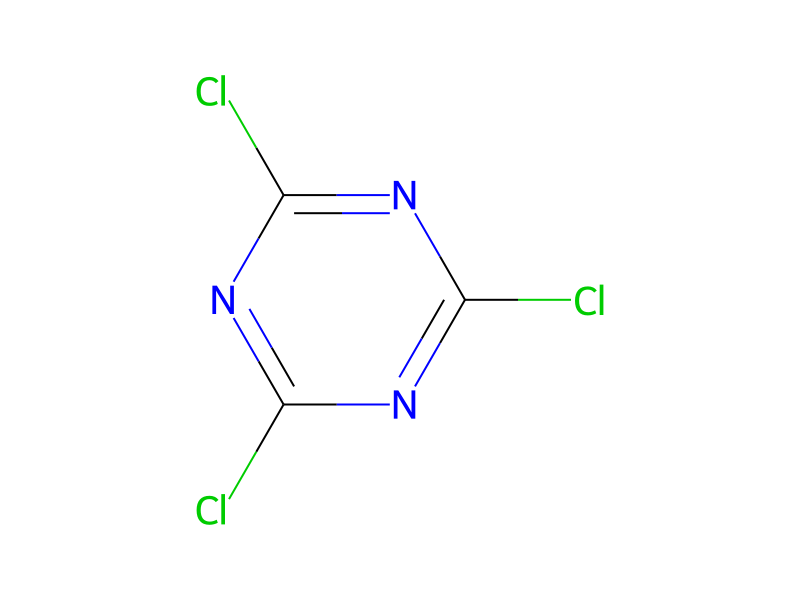

Product 1

Reagents, catalysts & solvents 1

Procedure
Reference is now made to the drawing, which is a flow chart of an exemplary completely integrated process of the present invention for conversion of cyanuric chloride to capped polymer. Cyanuric chloride (CYCI) dissolved in a suitable solvent, preferably toluene, is introduced into the system via line 1, and phase transfer catalyst (PTC) is added at 2. Mesitol and aqueous base are added from vessels 3 and 4, the rates of addition being controlled by valves 5 and 6 respectively. The reactant mixture then passes into static mixer 7, the residence time therein being effective to produce a toluene solution of the desired 2,4-dichloro-6-mesitoxy-1,3,5-triazine (DCMT).
Workup
- customto capped polymer
- additionis introduced into the system via line 1, and phase transfer catalyst (PTC)
- additionis added at 2
- additionthe rates of addition
Sources & evidence
- ORD record
- ord-f1ac1b7977c544eb8b7e07f181da23bb
- Source dataset
- uspto-grants-1995_08
- Patent number
- US05446155
Reaction notes
Loading…