Pyrrole → 14006-85-0
Reaction equation

N1C=[CH:4][CH:3]=[CH:2]1.[CH3:6][C:7]1[NH:8][CH:9]=[C:10]([CH3:12])[CH:11]=1>>[CH3:12][C:10]1[C:11]2[CH2:4][CH2:3][CH2:2][CH2:6][C:7]=2[NH:8][CH:9]=1Participants
Reactant 2
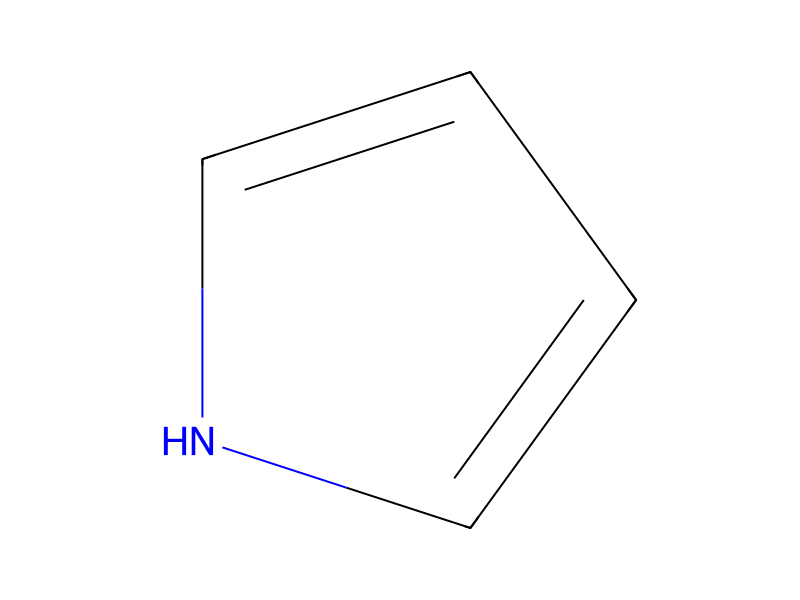

Product 1

Procedure
Conversion of α-pyrrolecarboxylate esters to α-unsubstituted pyrroles by treatment with phosphoric acid provided a convenient preparation of pyrrole 5b and was extended to 3-n-propyl, 3-n-butyl, and 3-isopropyl derivatives 5d-f of 2,4-dimethylpyrrole 5a. A similar conversion afforded 3-methyl-4,5,6,7-tetrahydroindole 5i from its 2-carboxylate ester derivative 4i. Unsuccessful attempts to extend the method to the preparation of 2,4-dimethyl-3-tert-butylpyrrole 5g led instead to the replacement of both the carboethoxy and tert-butyl groups with hydrogen to give 2,4-dimethylpyrrole 5a. The pyrroles 5g, j, k were obtained from ethyl 3',5'-dimethyl-4-tert-butylpyrrole-2-carboxylate 4g, ethyl 3-methyl-2,4,5,6-tetrahydrocyclopenta[c]pyrrolecarboxylate 4j, and ethyl 3,4-diethyl-5-methylpyrrole-2-carboxylate 4k by saponification with potassium hydroxide followed by decarboxylation of the free acids in ethanolamine at 180° C.
Sources & evidence
- ORD record
- ord-b463d118b7d34204915120942211fe5b
- Source dataset
- uspto-grants-1995_08
- Patent number
- US05446157
Reaction notes
Loading…