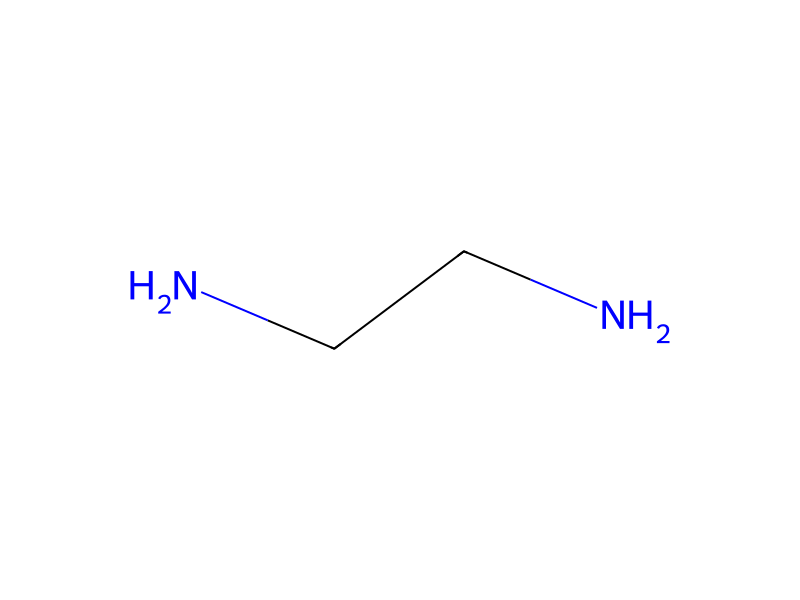
Ethylenediamine → (Trimethoxysilylpropyl)ethylenediamine
Reaction equation

[CH2:1]([NH2:4])[CH2:2][NH2:3].Cl[CH2:6][CH2:7][CH2:8][Si:9]([O:14][CH3:15])([O:12][CH3:13])[O:10][CH3:11].C(N)CN.ClCCC[Si](OC)(OC)OC>>[NH2:3][CH2:2][CH2:1][NH:4][CH2:6][CH2:7][CH2:8][Si:9]([O:14][CH3:15])([O:12][CH3:13])[O:10][CH3:11]Participants


Procedure
A 200-ml, four necked glass flask equipped with a stirrer, reflux condenser, and thermometer was charged with 72.0 g (1.2 mol) of ethylene diamine and heated at 112° to 117° C. From a dropping funnel, 59.6 g (0.3 mol) of 3-chloropropyltrimethoxysilane was added dropwise to the flask over 2 hours (the molar ratio of ethylene diamine/3-chloropropyltrimethoxysilane=4.0). After one hour ripening, the reaction solution was transferred to a separatory funnel and cooled for allowing the solution to separate into two layers. The lower layer of ethylene diamine hydrochloride was separated off. The upper layer containing 3-[N-(2-aminoethyl)]aminopropyltrimethoxysilane was taken out and purified by simple distillation, obtaining 46.8 g of 3-[N-(2-aminoethyl)]aminopropyltrimethoxysilane. The yield was 70.1%. A substantial amount of bis-silyl products was detected.
Workup
- customA 200-ml, four necked glass flask equipped with a stirrer
- temperaturereflux condenser
- temperatureheated at 112° to 117° C
- customthe reaction solution was transferred to a separatory funnel
- temperaturecooled
- customto separate into two layers
- customThe lower layer of ethylene diamine hydrochloride was separated off
- additionThe upper layer containing 3-[N-(2-aminoethyl)]aminopropyltrimethoxysilane
- distillationpurified by simple distillation
Sources & evidence
- ORD record
- ord-cbd8f978f43140048f9f8d5ac71a964f
- Source dataset
- uspto-grants-1995_08
- Patent number
- US05446181
Reaction notes
Loading…