Azobisisobutyronitrile → 5-Bromomethyl-2-cyclopropyl-7-fluoro-6-phenyl-1,3-benzoxazole-4-carbonitrile
Reaction equation
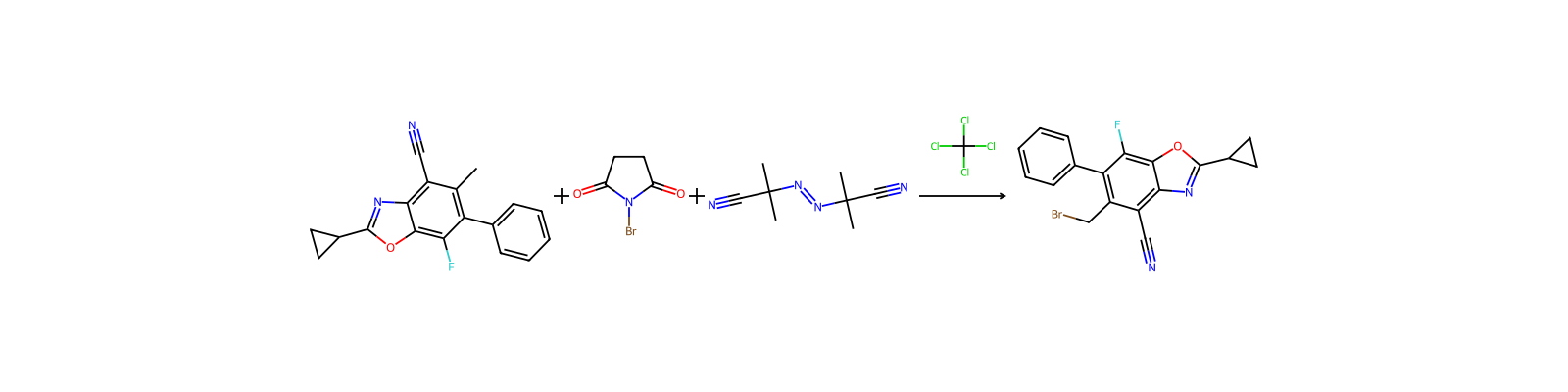
[CH:1]1([C:4]2[O:5][C:6]3[C:7](=[C:9]([C:21]#[N:22])[C:10]([CH3:20])=[C:11]([C:14]4[CH:19]=[CH:18][CH:17]=[CH:16][CH:15]=4)[C:12]=3[F:13])[N:8]=2)[CH2:3][CH2:2]1.[Br:23]N1C(=O)CCC1=O.N(C(C)(C)C#N)=NC(C)(C)C#N>C(Cl)(Cl)(Cl)Cl>[Br:23][CH2:20][C:10]1[C:9]([C:21]#[N:22])=[C:7]2[N:8]=[C:4]([CH:1]3[CH2:3][CH2:2]3)[O:5][C:6]2=[C:12]([F:13])[C:11]=1[C:14]1[CH:15]=[CH:16][CH:17]=[CH:18][CH:19]=1Participants
5
Reactant 3



Product 1

Reagents, catalysts & solvents 1

Procedure
Under nitrogen atmosphere, a carbon tetrachloride (12 ml) solution of 2-cyclopropyl-7-fluoro-5-methyl-6-phenyl-1,3-benzoxazole-4-carbonitrile (I-173) (1.00 g, 3.42 mmol), N-bromosuccinimide (913 mg, 5.13 mmol) and 2,2′-azobis(isobutyronitrile) (56 mg, 342 μmol) was stirred at 80° C. for 13 hours. After cooling, the solvent was evaporated away under reduced pressure, and the resulting residue was purified by middle-pressure liquid chromatography (eluent, n-hexane:ethyl acetate=5:1, v/v) to obtain the entitled compound (1.04 g, 82%) as a white solid.
Workup
- temperatureAfter cooling
- customthe solvent was evaporated away under reduced pressure
- customthe resulting residue was purified by middle-pressure liquid chromatography (eluent, n-hexane
Sources & evidence
- ORD record
- ord-47d0fdc2d3bc49bc920e4ded3dc1103f
- Source dataset
- uspto-grants-2010_06
- Patent number
- US07737166B2
Reaction notes
Loading…