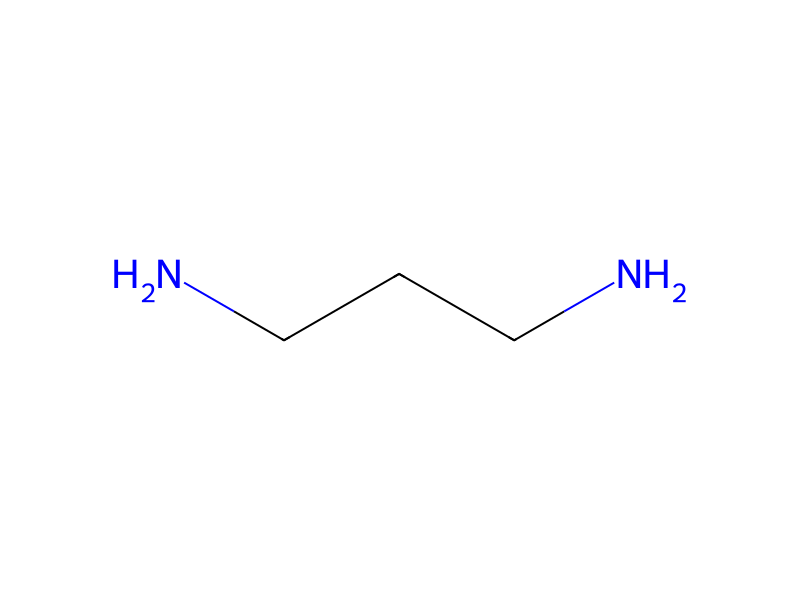
1,3-Propanediamine → HCID 178442378, compound
Reaction equation

Cl[C:2](Cl)=[N:3][C:4]1[CH:9]=[CH:8][C:7]([CH:10]2[CH2:15][CH2:14][CH2:13][CH2:12][CH2:11]2)=[CH:6][CH:5]=1.[NH2:17][CH2:18][CH2:19][CH2:20][NH2:21].C(N(CC)CC)C>C(#N)C>[CH2:10]([C:7]1[CH:6]=[CH:5][C:4]([N:3]=[C:2]2[NH:21][CH2:20][CH2:19][CH2:18][NH:17]2)=[CH:9][CH:8]=1)[CH2:15][CH2:14][CH2:13][CH2:12][CH3:11]Participants
Reactant 3


Product 1

Reagents, catalysts & solvents 1

Procedure
A solution of 2.6 g of N-dichloromethylene 4-cyclohexylaniline in 40 ml of acetonitrile is added dropwise to a solution of 1 ml of 1,3-diaminopropane in 20 ml of acetonitrile in 15 minutes at room temperature. After the addition of 1 ml of triethylamine, the solution is stirred for 1 hour at room temperature, after which the reaction mixture is filtered while warm. After distilling off the solvent the residue is taken up in ether and successively washed with 2 N sodium hydroxide solution and water. The ether layer is dried and evaporated, after which the residue is recrystallized from acetonitrile. The resulting 2-(4-cyclohexylphenyl)imino-hexahydropyrimidine has a melting point of 180°-182° C. 2-(4-n-hexylphenyl)imino-hexahydropyrimidine was prepared in a corresponding manner.
Workup
- filtrationafter which the reaction mixture is filtered
- temperaturewhile warm
- distillationAfter distilling off the solvent the residue
- washsuccessively washed with 2 N sodium hydroxide solution and water
- dry with materialThe ether layer is dried
- customevaporated
- customafter which the residue is recrystallized from acetonitrile
Sources & evidence
- ORD record
- ord-402d7d4c360148518aff78e9f8940aef
- Source dataset
- uspto-grants-1983_02
- Patent number
- US04374143
Reaction notes
Loading…