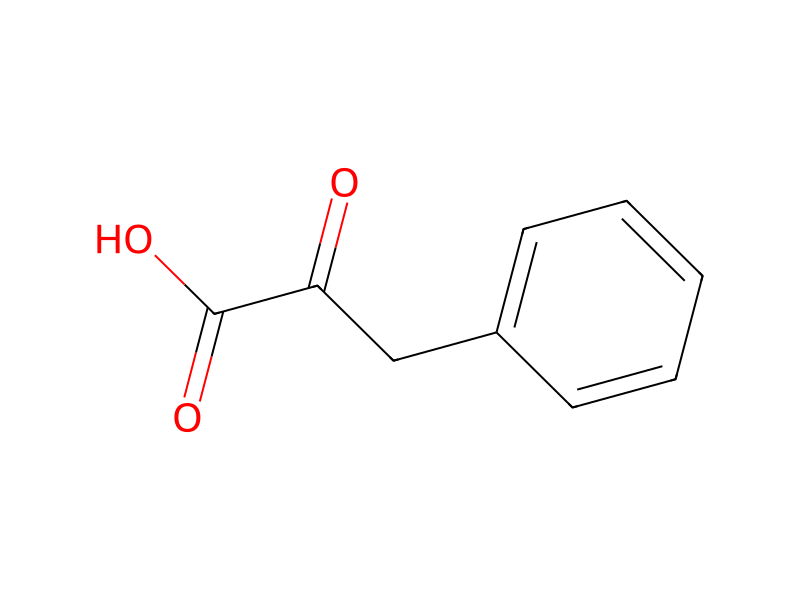
Phenylpyruvic acid → HCID 54518889, compound
Reaction equation

[C:1]1([CH2:7][C:8](=O)[C:9]([OH:11])=[O:10])[CH:6]=[CH:5][CH:4]=[CH:3][CH:2]=1.[NH2:13][C@H:14]([C:16]([N:18]1[CH2:25][CH2:24][CH2:23][C@H:19]1[C:20]([OH:22])=[O:21])=[O:17])[CH3:15].C([BH3-])#N.[Na+]>CO.O>[C:9]([CH:8]([NH:13][C@H:14]([C:16]([N:18]1[CH2:25][CH2:24][CH2:23][C@H:19]1[C:20]([OH:22])=[O:21])=[O:17])[CH3:15])[CH2:7][C:1]1[CH:6]=[CH:5][CH:4]=[CH:3][CH:2]=1)([OH:11])=[O:10]Participants
5
Reactant 3


Product 1

Reagents, catalysts & solvents 1

Procedure
A mixture of phenylpyruvic acid (753 mg) and L-alanyl-L-proline (171 mg) in methanol-water are adjusted to pH 6.8 and treated with sodium cyanoborohydride (173 mg) at room temperature until reaction is complete. The product is absorbed on strong cation exchange resin and eluted with 2% pyridine in water to give 294 mg of crude diastereomeric product, N-(1-carboxy-2-phenylethyl)-L-alanyl-L-proline. A portion is purified by gel filtration (LH-20) for spectrographic analysis. The nmr spectrum shows a broad singlet at 7.2, complex absorption from 3.0 to 4.6, a multiplet at 2.1 and a pair of doublets at 1.5 ppm.
Workup
- customThe product is absorbed on strong cation exchange resin
- washeluted with 2% pyridine in water
Sources & evidence
- ORD record
- ord-22c246ac6bb14431aafba7c2a68193be
- Source dataset
- uspto-grants-1983_02
- Patent number
- US04374829
Reaction notes
Loading…