Sulfuric Acid → 4,4-Dimethyl-3,5,8-trioxabicyclo[5.1.0]octane
Reaction equation

[CH3:1][C:2]1([CH3:9])[O:8][CH2:7][CH:6]=[CH:5][CH2:4][O:3]1.S(=O)(=O)(O)[OH:11].ClOC(C)(C)C.S(=O)(O)[O-].[Na+].[OH-].[Na+]>C(O)(C)(C)C>[CH3:1][C:2]1([CH3:9])[O:8][CH2:7][CH:6]2[CH:5]([O:11]2)[CH2:4][O:3]1Participants
Reactant 5




Product 1

Reagents, catalysts & solvents 1

Procedure
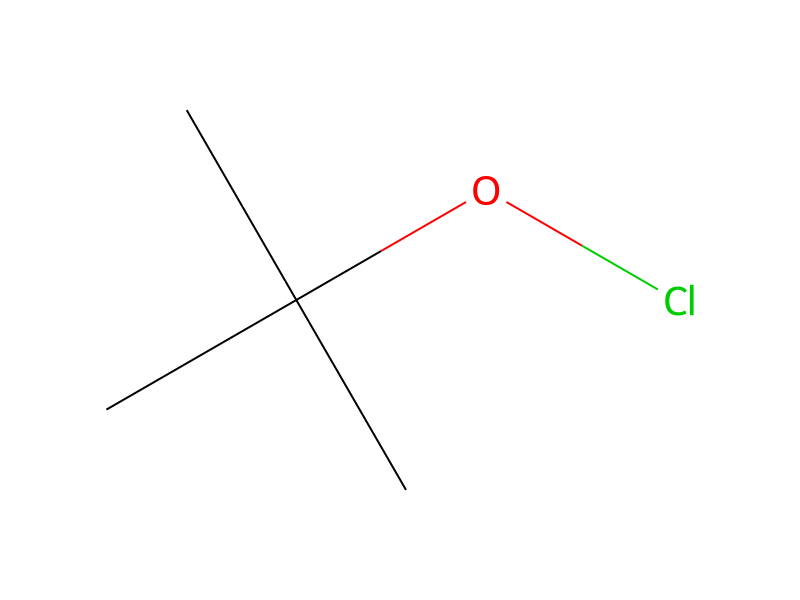
To an ice-cold (5°), stirred solution of the dioxepin (II) (12.81 g, 0.1 mole) in aqueous t-butanol (50%; 50 ml) adjusted to pH 6.0 with dilute sulfuric acid, was added t-butyl hypochlorite (11.3 g, 0.105 mole), while the pH was maintained at 6.0. The reaction mixture was allowed to rise to room temperature and stirred for 4 hrs with protection from light. Sodium bisulfite (200 mg) was added to the reaction mixture, followed by 50% aqueous sodium hydroxide to bring the pH to 12. The reaction mixture was heated at 100° for 1 hr and then cooled. The upper t-butanol layer was separated and the aqueous layer was extracted with t-butanol (3×20 ml). The combined organic layers were dried (Na2CO3). Solvent removal, followed by fractional distillation, gave the epoxide product (III) as a colorless oil in ≅80% yield.
Workup
- temperaturewhile the pH was maintained at 6.0
- customto rise to room temperature
- temperatureThe reaction mixture was heated at 100° for 1 hr
- temperaturecooled
- customThe upper t-butanol layer was separated
- extractionthe aqueous layer was extracted with t-butanol (3×20 ml)
- dry with materialThe combined organic layers were dried (Na2CO3)
- customSolvent removal
- distillationfollowed by fractional distillation
Sources & evidence
- ORD record
- ord-3ab110dcb0c04993a49c74034b3581e8
- Source dataset
- uspto-grants-1982_07
- Patent number
- US04341756
Reaction notes
Loading…