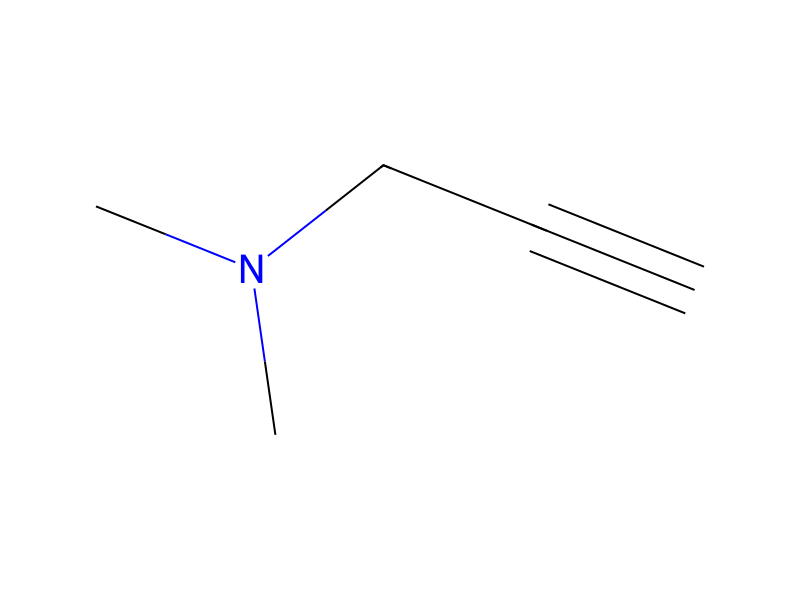
N,N-Dimethylpropargylamine → HCID 22048131, compound
Reaction equation

[NH:1]([C:8]1[C:13]([Br:14])=[CH:12][N:11]=[C:10]([NH:15][C:16]2[CH:21]=[CH:20][C:19](I)=[CH:18][CH:17]=2)[N:9]=1)[C:2]1[CH:7]=[CH:6][CH:5]=[CH:4][CH:3]=1.[CH3:23][N:24]([CH2:26][C:27]#[CH:28])[CH3:25]>N1CCCC1.C(Cl)Cl>[NH:1]([C:8]1[C:13]([Br:14])=[CH:12][N:11]=[C:10]([NH:15][C:16]2[CH:21]=[CH:20][C:19]([C:28]#[C:27][CH2:26][N:24]([CH3:25])[CH3:23])=[CH:18][CH:17]=2)[N:9]=1)[C:2]1[CH:7]=[CH:6][CH:5]=[CH:4][CH:3]=1Participants
5
Reactant 2

Product 1

Reagents, catalysts & solvents 2


Conditions
- Temperature
- 80 °C
Procedure
A solution of 4-anilino-5-bromo-2-(4-iodoanilino)pyrimidine (Method 12; 200 mg, 0.40 mmol), N,N-dimethylpropargylamine (0.09 ml, 0.85 mmol) and tetrakis (triphenylphosphine)palladium (0) (25 mg, 0.02 mmol) in pyrrolidine (3 ml) was stirred for 60 hours and then heated at 80° C. for 2 hours. The mixture was diluted with DCM (10 ml) and silica (2 g) was added. Volatile material was removed by evaporation and the residue was loaded onto a Varian Mega Bond Elut column. Elution with 0-10% 2.0M methanolic ammonia solution in DCM gave the product (30 mg, 17%). NMR: 2.2 (s, 6H), 3.4 (s, 2H), 7.2 (m, 3H), 7.4 (m, 2H), 7.6 (m, 4H), 8.2 (s, 1H), 8.6 (s, 1H), 9.5 (s, 1H); MS (MH+): 422.3, 424.3.
Workup
- additionwas added
- customVolatile material was removed by evaporation
- washElution with 0-10% 2.0M methanolic ammonia solution in DCM
Sources & evidence
- ORD record
- ord-8df634f8b527430d93248856b0f9ed87
- Source dataset
- uspto-grants-2005_01
- Patent number
- US06838464B2
Reaction notes
Loading…