1-Methoxy-2-propanol → Pyridine, 2,3,5-trichloro-
Reaction equation
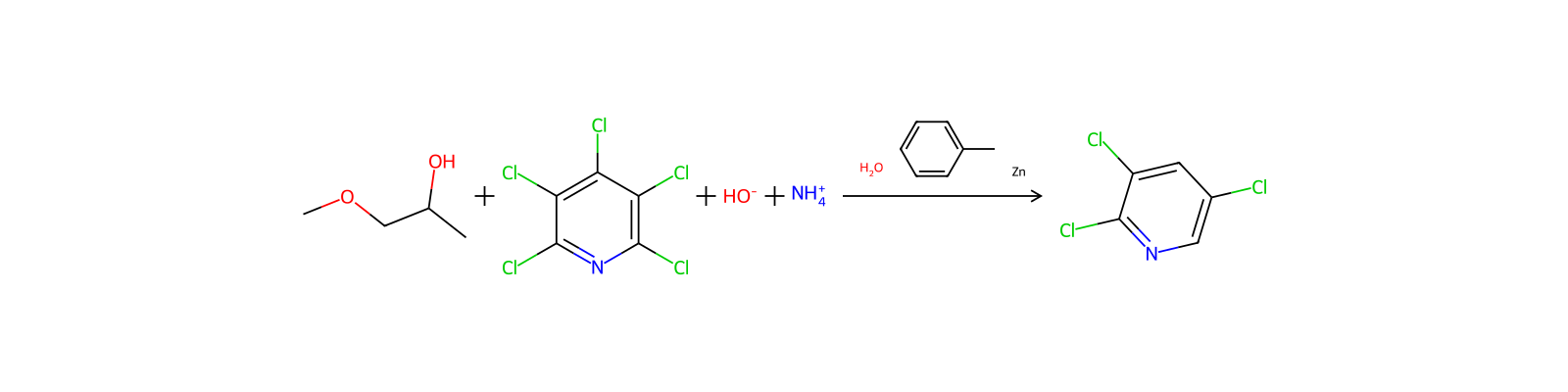
COCC(O)C.Cl[C:8]1[N:13]=[C:12]([Cl:14])[C:11]([Cl:15])=[C:10](Cl)[C:9]=1[Cl:17].[OH-].[NH4+]>O.C1(C)C=CC=CC=1.[Zn]>[Cl:14][C:12]1[C:11]([Cl:15])=[CH:10][C:9]([Cl:17])=[CH:8][N:13]=1Participants
Reactant 3



Product 1

Reagents, catalysts & solvents 3



Procedure
To a 500 milliliter, 3-neck flask which was fitted with a reflux condenser, thermometer, stirrer and heater was added 100 milliliters of 1-methoxy-2-propanol, 25.1 grams (0.10 mole) of pentachloropyridine and 39.0 grams (0.60 gram atom) of zinc dust. The flask was heated, with stirring, to 90° C. until all the pentachloropyridine was dissolved. At this time, 100 milliliters of concentrated ammonium hydroxide was added over a 5 hour period. The pH of the mixture was ~12. The mixture was refluxed for 32 hours and the reaction mixture was diluted with two volumes of water and 100 milliliters of toluene. The mixture was filtered to remove insolubles. The toluene was removed by fractionation leaving 30.0 grams of crude 2,3,5-trichloropyridine as an amber-colored oil. Analysis by gas-liquid chromatography showed a yield of 2.1 grams of the desired product (12 percent of theoretical).
Workup
- customTo a 500 milliliter, 3-neck flask which was fitted with a reflux condenser
- temperatureThe flask was heated
- dissolutionwas dissolved
- temperatureThe mixture was refluxed for 32 hours
- filtrationThe mixture was filtered
- customto remove insolubles
- customThe toluene was removed by fractionation
Sources & evidence
- ORD record
- ord-d190ba956e554f28997ff2087e410686
- Source dataset
- uspto-grants-1978_09
- Patent number
- US04111938
Reaction notes
Loading…