Water → 3-(4-Fluorophenyl)-5,7-dihydroxy-2-methyl-4H-1-benzopyran-4-one
Reaction equation

O[C:2]1C=C(O)C=C(O)[C:3]=1[CH:10]([C:18](C(C1C(O)=CC(O)=CC=1O)C1C=CC(F)=CC=1)=[O:19])[C:11]1[CH:16]=[CH:15][C:14]([F:17])=[CH:13][CH:12]=1.B(F)(F)F.CC[O:43][CH2:44][CH3:45].CS(Cl)(=O)=O.[OH2:51]>CC(N(C)C)=O>[OH:51][C:3]1[C:10]2[C:18](=[O:19])[C:10]([C:11]3[CH:16]=[CH:15][C:14]([F:17])=[CH:13][CH:12]=3)=[C:3]([CH3:2])[O:19][C:18]=2[CH:45]=[C:44]([OH:43])[CH:2]=1Participants



Procedure
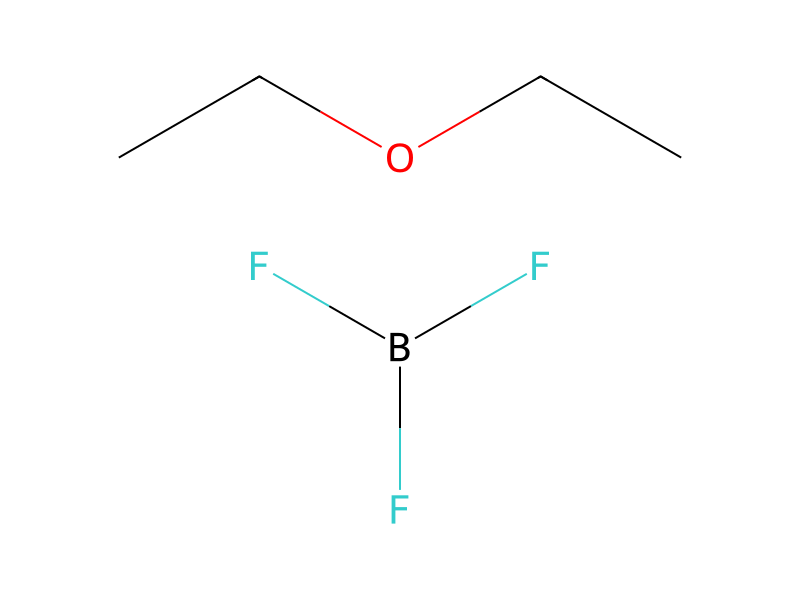
2,4,6-Trihydroxy-phenyl 4-fluoro-benzyl-ketone (1.31 g, 5 mmole) was dissolved in dimethylacetamide (5.0 ml) and borontrifluoride etherate (2.1 g, 15 mmole) was added cautiously. This solution was then added to a solution of methane-sulphonyl chloride (1.71 g, 15 mmole) in dimethylacetamide (5 ml) and the resulting mixture was heated on the steam batch for 75 minutes. The reaction mixture was poured into cold water (75 ml) and the crystalline diacetate was collected by filtration. The product was hydrolysed by heating in 50% methanolic hydrochloric acid (20 ml, 5N) at reflux for 1 hour, the solution was poured into excess cold water and the crystalline precipitate was collected and dried to give 5,7-dihydroxy-3-p-fluoro-phenyl-2-methyl-4-oxo-4H-benzopyran, m.p. 222°-223°. NMR of the diacetate confirmed that cyclisation had taken place. The product was identical on T.L.C. with a sample prepared via the standard Allen-Robinson synthesis.
Workup
- temperaturethe resulting mixture was heated on the steam batch for 75 minutes
- filtrationthe crystalline diacetate was collected by filtration
- temperatureby heating in 50% methanolic hydrochloric acid (20 ml, 5N)
- temperatureat reflux for 1 hour
- additionthe solution was poured into excess cold water
- customthe crystalline precipitate was collected
- customdried
Sources & evidence
- ORD record
- ord-a41e4abdda4a49a3942f474ee3301aa4
- Source dataset
- uspto-grants-1978_09
- Patent number
- US04117149
Reaction notes
Loading…