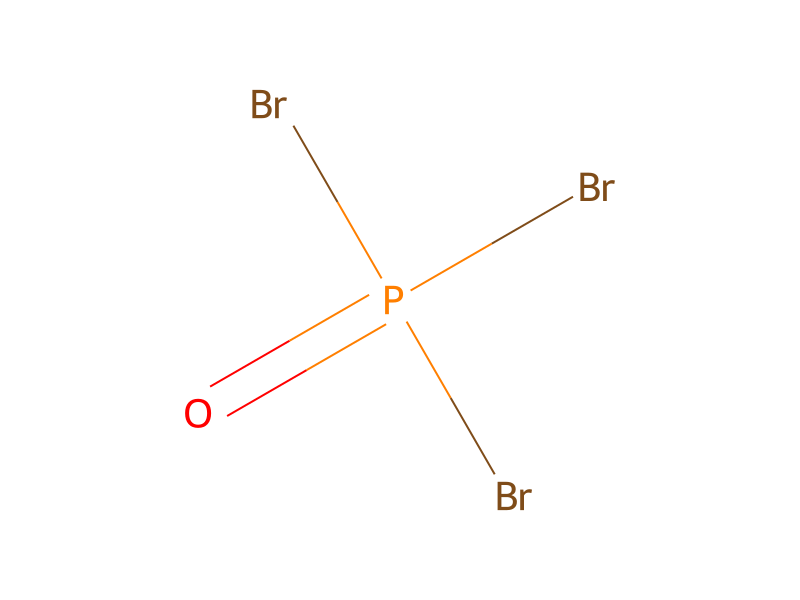
Phosphorus oxybromide → 4-Bromo-2-(4-isopropylphenyl)-2H-phthalazin-1-one
Reaction equation

O[C:2]1[C:11]2[C:6](=[CH:7][CH:8]=[CH:9][CH:10]=2)[C:5](=[O:12])[N:4]([C:13]2[CH:18]=[CH:17][C:16]([CH:19]([CH3:21])[CH3:20])=[CH:15][CH:14]=2)[N:3]=1.P(Br)(Br)([Br:24])=O.C(C1C=C(C)C=C(C(C)(C)C)C=1O)(C)(C)C>O>[Br:24][C:2]1[C:11]2[C:6](=[CH:7][CH:8]=[CH:9][CH:10]=2)[C:5](=[O:12])[N:4]([C:13]2[CH:18]=[CH:17][C:16]([CH:19]([CH3:21])[CH3:20])=[CH:15][CH:14]=2)[N:3]=1Participants
5
Reactant 3


Product 1

Reagents, catalysts & solvents 1

Procedure
4-Hydroxy-2-(4-isopropylphenyl)-2H-phthalazin-1-one (0.10 g, 0.36 mmol), phosphorus oxybromide (0.41 g, 1.4 mmol) and 2,6-di-tert-butyl-4-methylphenol (0.02 g, 0.09 mmol) were stirred at 150° C. for 30 min. H2O (100 ml) was added after cooling to room temperature. Extraction with dichloromethane, drying of the combined organic phases over Na2SO4 and evaporation of the solvent yielded the desired compound (0.05 g, 41%) which was used without any further characterization.
Workup
- extractionExtraction with dichloromethane
- dry with materialdrying of the combined organic phases over Na2SO4 and evaporation of the solvent
Sources & evidence
- ORD record
- ord-397833bfd4b249429ac7f3d35be299c2
- Source dataset
- uspto-grants-2007_06
- Patent number
- US07226923B2
Reaction notes
Loading…