Benzoic acid, 5-chloro-2-hydroxy-, methyl ester → 1,3-Cyclohexadiene
Reaction equation

[Cl:1][C:2]1[CH:11]=[C:6]([C:7]([O:9][CH3:10])=[O:8])[C:5]([OH:12])=[CH:4][CH:3]=1>CCOCC>[CH:11]1[CH2:6][CH2:5][CH:4]=[CH:3][CH:2]=1.[Cl:1][C:2]1[CH:11]=[C:6]([C:7]([O:9][CH3:10])=[O:8])[C:5]([OH:12])=[CH:4][CH:3]=1Participants
Reactant 1
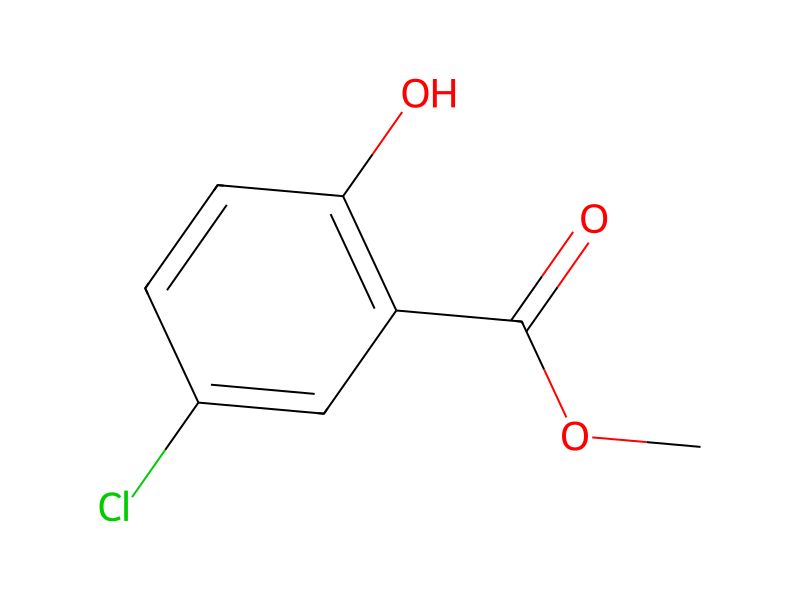
Product 2
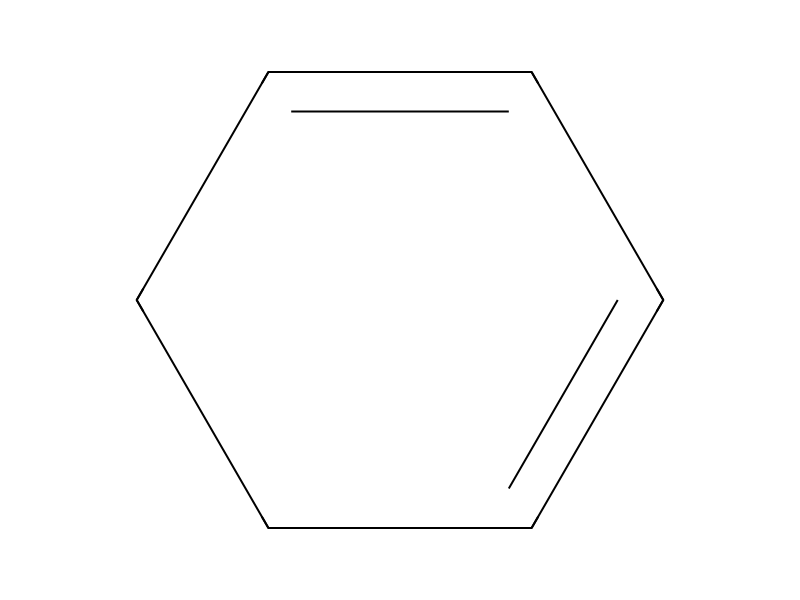
Reagents, catalysts & solvents 1

Procedure
This is a more direct approach to obtain a stereospecific synthesis and describes the Claisen rearrangement with a chiral ether (4). S-2-Cyclohexene-1-ol was obtained by asymmetric ring opening of cyclohexene oxide. A Mitsunobu condensation between S-cyclohexanol and methyl 5-chlorosalicylate provided the chiral ether 4. The thermal Claisen rearrangement of 4 afforded 5 in moderate yield along with the products of elimination, cyclohexadiene and methyl 5-chloro-salicylate. Acid catalyzed intramolecular cyclization yielded a 3 to 1 mixture of structural isomers shown in Scheme II. The benzofuran isomer is the kinetic product and can be converted to the thermodynamically favored benzoxocin isomer by treatment with concentrated sulfuric acid as reported earlier (R. D. Youssefyeh et al. J. Med. Chem. 1992, 35, 903). Upon hydrolysis with lithium hydroxide the benzofuran isomer precipitates out as the lithium salt and is easily separated by filtration. Acidification of this material yields 2-chloro-[5a(S)-9a(S)-(5a,6,7,8,9,9a-hexahydro)]dibenzofuran-4-carboxylic acid (3 S,S) in 5 steps, which is similar to the material obtained by classical resolution, the structural determination of which was made by X-ray crystallography. The Claisen rearrangement using S-cyclohexanol proceeds in only moderate yield, and one quarter to one third of the chiral material obtained is lost as the benzopyran isomer.
Workup
- customThe thermal Claisen rearrangement of 4 afforded 5
Sources & evidence
- ORD record
- ord-80d0918ef14f4f94b576cff4d55f9037
- Source dataset
- uspto-grants-1995_01
- Patent number
- USH0001406
Reaction notes
Loading…