1,4-Dichlorobenzene → Phthalic Anhydride
Reaction equation

C1C(Cl)=CC=C(Cl)C=1.Cl[C:10]1[CH:11]=[C:12]([C:19]([O-:21])=[O:20])[C:13](=[CH:17][CH:18]=1)[C:14]([OH:16])=O.[Na+].[OH-].[Na+]>O.CN1C(=O)CCC1>[C:19]1(=[O:20])[O:21][C:14](=[O:16])[C:13]2=[CH:17][CH:18]=[CH:10][CH:11]=[C:12]12Participants
6
Reactant 3



Product 1
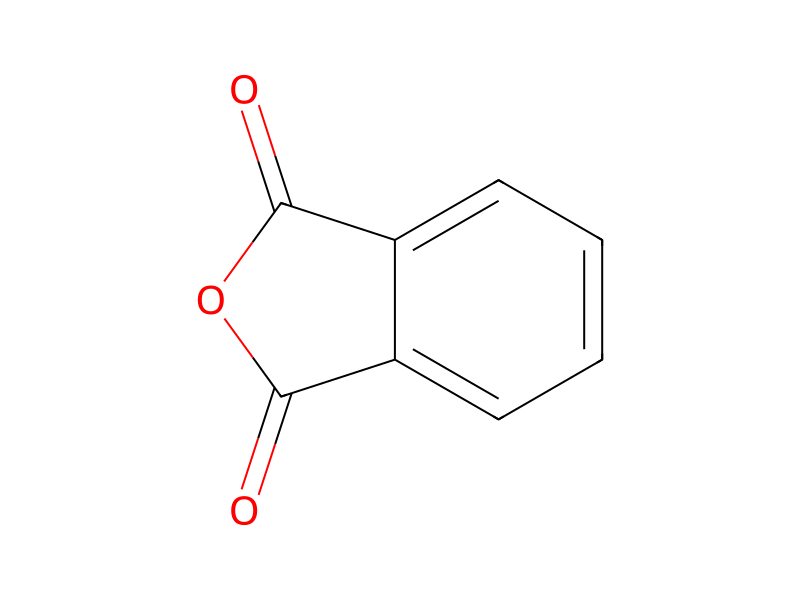
Reagents, catalysts & solvents 2


Conditions
- Temperature
- 255 °C
Procedure
Then, 1116.5 g (7.59 moles) of p-dichlorobenzene, 1540.2 g of NMP and 32.7 g of water were fed to react the contents at a temperature of 220° C. for 4.5 hours. Thereafter, 282 g (15.7 moles) of water, 175.9 g (0.790 mole) of sodium hydrogen 4-chlorophthalate and 31.32 g (0.783 mole) of sodium hydroxide were additionally introduced under pressure in the autoclave. The contents were heated up to 255° C. to react them for 5 hours.
Workup
- customto react the contents at a temperature of 220° C. for 4.5 hours
- customto react them for 5 hours
Sources & evidence
- ORD record
- ord-3d34d4e1c9e5442a99e663d3af9881e6
- Source dataset
- uspto-grants-1995_01
- Patent number
- US05380819
Reaction notes
Loading…