Hydrochloric Acid → Chlorodicyclohexylborane
Reaction equation

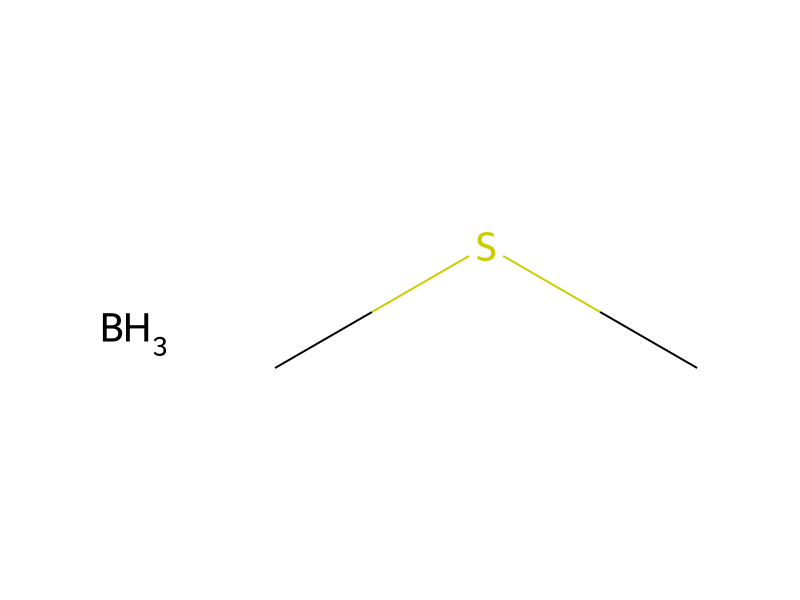
[CH:1]1[CH2:6][CH2:5][CH2:4][CH2:3][CH:2]=1.[BH3:7].CSC.[ClH:11].[H][H]>C(OCC)C.[Hg]>[CH:1]1([B:7]([CH:1]2[CH2:6][CH2:5][CH2:4][CH2:3][CH2:2]2)[Cl:11])[CH2:6][CH2:5][CH2:4][CH2:3][CH2:2]1Participants






Procedure
A 500-mL round-bottom flask capped with a rubber septum, a magnetic stirring bar, and a connecting tube attached to a mercury bubbler was charged with diethyl ether (150 mL) and cyclohexene (41 mL, 400 mmol). The flask was cooled in an ice bath, borane-methyl sulfide (BMS, 20 mL, 200 mmol) was added slowly, and stirring was continued for 3 h at O° C. Dicyclohexylborane precipitated as a white solid. The supernatant liquid was removed by a double-ended needle, the solid was washed with ether, and the liquid was removed. Then the solid was suspended in 100 mL of diethyl ether, and anhydrous HCl in ether (66.7 mL of 3M solution, 200 mmol) was added slowly to the suspension at 0° C. Hydrogen is rapidly evolved and should be safely vented. A clear solution was obtained. The 11B NMR analysis of the resulting solution showed formation of Chx2BCl (δ66 ppm in diethyl ether). Distillation provides the pure title product (δ76 ppm in hexane), 31.6 g, 75% yield, bp 95°-96° C. (0.35 mm).
Workup
- customA 500-mL round-bottom flask capped with a rubber septum, a magnetic stirring bar, and a connecting tube
- temperatureThe flask was cooled in an ice bath
- customDicyclohexylborane precipitated as a white solid
- customThe supernatant liquid was removed by a double-ended needle
- washthe solid was washed with ether
- customthe liquid was removed
- customA clear solution was obtained
- distillationDistillation
Sources & evidence
- ORD record
- ord-1f53ebc3e3ea4969b3b6d3bed9ff230f
- Source dataset
- uspto-grants-1995_01
- Patent number
- US05380940
Reaction notes
Loading…