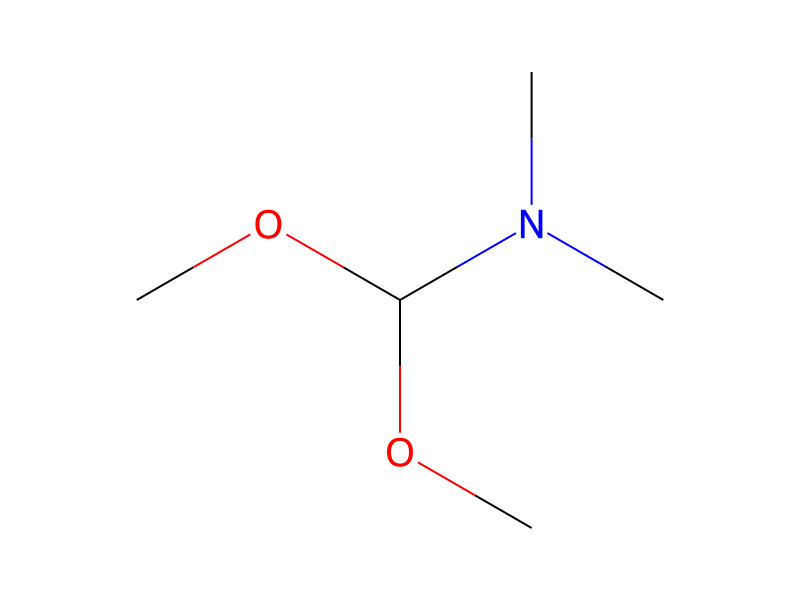
Dimethylformamide dimethyl acetal → 4-(3,5-ditert-butyl-4-hydroxy-phenyl)-2-dimethylamino-N-methyl-pyrimidine-5-carboxamide
Reaction equation

[CH3:1][NH:2][C:3](=[O:22])[CH2:4][C:5]([C:7]1[CH:12]=[C:11]([C:13]([CH3:16])([CH3:15])[CH3:14])[C:10]([OH:17])=[C:9]([C:18]([CH3:21])([CH3:20])[CH3:19])[CH:8]=1)=O.[CH3:23]OC(OC)N(C)C.S(O)(O)(=O)=O.[CH3:36][N:37]([CH3:41])[C:38]([NH2:40])=[NH:39].CC(C)([O-])C.[K+]>C(O)(C)(C)C.O.C(OCC)(=O)C.C1(C)C=CC=CC=1>[C:18]([C:9]1[CH:8]=[C:7]([C:5]2[C:4]([C:3]([NH:2][CH3:1])=[O:22])=[CH:23][N:40]=[C:38]([N:37]([CH3:41])[CH3:36])[N:39]=2)[CH:12]=[C:11]([C:13]([CH3:15])([CH3:14])[CH3:16])[C:10]=1[OH:17])([CH3:19])([CH3:21])[CH3:20]Participants
Reactant 4



Product 1

Reagents, catalysts & solvents 4




Conditions
- Temperature
- 80 °C
Procedure
A 50-mL round bottom flask was charged with 3-(3,5-ditert-butyl-4-hydroxy-phenyl)-3-oxo-propanoic acid methyl amide (2.69 g, 8.81 mmol) and toluene (18 mL). The mixture was warmed to give a solution, then N,N-dimethylformamide dimethyl acetal (1.46 mL, 11 mmol) was added while the solution was still hot. The mixture was stirred for 2.5 h then evaporated. The residue was taken up in 2-propanol (28 mL) and 1,1-dimethylguanidine sulfate (1.80 g, 6.6 mmol) was added. The mixture was stirred at room temperature and a 1 M solution of potassium tert-butoxide in tert-butanol (21 mL) was added and the mixture was immersed into a bath maintained at 80° C. and stirred for 4 hours then at 50° C. overnight. The mixture was allowed to cool to room temperature, and was equilibrated with ethyl acetate (80 mL) and water (60 mL). The organic layer was washed with water (2×25 mL), once with brine (20 mL) then dried with sodium sulfate and evaporated to a brown solid. This material was boiled in dichloromethane (200 mL) without dissolving all solids. The mixture was allowed to cool and was filtered. The brown filtrate was charged to a column of silica gel G (70-230 mesh) in dichloromethane and using 1:4, 1:2, 1:1 ethyl acetate-hexane and ethyl acetate as mobile phases. The product was eluted with ethyl acetate and crystallized partly in the receptacles. The appropriate fractions were evaporated and the residue dissolved in a boiling ethanol-acetone mixture. The solution was concentrated, the resulting suspension diluted with cyclohexane and refrigerated. The solids were washed with 1:2 ethyl acetate-hexane to leave the title compound as a white powder, 1.52 g, 44.9% yield. TLC (ethyl acetate) Rf 0.73, TLC (1:1 ethyl acetate-hexane) Rf 0.20; 1H-NMR (300 MHz, DMSO-d6) δ 1.38 (9H, s), 2.64 (3H, d, J=4.5 Hz), 3.15 (6H, s), 7.60 (2H, s), 8.15 (1H, br s), 8.22 (1H, s).
Workup
- temperatureThe mixture was warmed
- customto give a solution
- customthen evaporated
- stirringThe mixture was stirred at room temperature
- customthe mixture was immersed into a bath
- stirringstirred for 4 hours
- customat 50° C.
- customovernight
- temperatureto cool to room temperature
- washThe organic layer was washed with water (2×25 mL), once with brine (20 mL)
- dry with materialthen dried with sodium sulfate
- customevaporated to a brown solid
- dissolutionwithout dissolving all solids
- temperatureto cool
- filtrationwas filtered
- additionThe brown filtrate was charged to a column of silica gel G (70-230 mesh) in dichloromethane
- washThe product was eluted with ethyl acetate
- customcrystallized partly in the receptacles
- customThe appropriate fractions were evaporated
- dissolutionthe residue dissolved in a boiling ethanol-acetone mixture
- concentrationThe solution was concentrated
- additionthe resulting suspension diluted with cyclohexane
- washThe solids were washed with 1:2 ethyl acetate-hexane
Sources & evidence
- ORD record
- ord-1cf05bc3311340bdb094c6003e8b9143
- Source dataset
- uspto-grants-2016_02
- Patent number
- US09249107B2
Reaction notes
Loading…