Diisopropylethylamine → 1-[4-(6-Fluoronaphthalen-2-yl)piperazin-1-yl]-2-[(4-[[4-nitro-3-(trifluoromethyl)phenyl]amino]cyclohexyl)oxy]ethan-1-one
Reaction equation

[N+:1]([C:4]1[CH:9]=[CH:8][C:7]([NH:10][CH:11]2[CH2:16][CH2:15][CH:14]([O:17][CH2:18][C:19]([OH:21])=O)[CH2:13][CH2:12]2)=[CH:6][C:5]=1[C:22]([F:25])([F:24])[F:23])([O-:3])=[O:2].CCN(C(C)C)C(C)C.CN(C(ON1N=NC2C=CC=NC1=2)=[N+](C)C)C.F[P-](F)(F)(F)(F)F.[F:59][C:60]1[CH:61]=[C:62]2[C:67](=[CH:68][CH:69]=1)[CH:66]=[C:65]([N:70]1[CH2:75][CH2:74][NH:73][CH2:72][CH2:71]1)[CH:64]=[CH:63]2>ClCCl>[F:59][C:60]1[CH:61]=[C:62]2[C:67](=[CH:68][CH:69]=1)[CH:66]=[C:65]([N:70]1[CH2:71][CH2:72][N:73]([C:19](=[O:21])[CH2:18][O:17][CH:14]3[CH2:15][CH2:16][CH:11]([NH:10][C:7]4[CH:8]=[CH:9][C:4]([N+:1]([O-:3])=[O:2])=[C:5]([C:22]([F:24])([F:23])[F:25])[CH:6]=4)[CH2:12][CH2:13]3)[CH2:74][CH2:75]1)[CH:64]=[CH:63]2Participants
Reactant 4
 HCID 81531Diisopropylethylamine
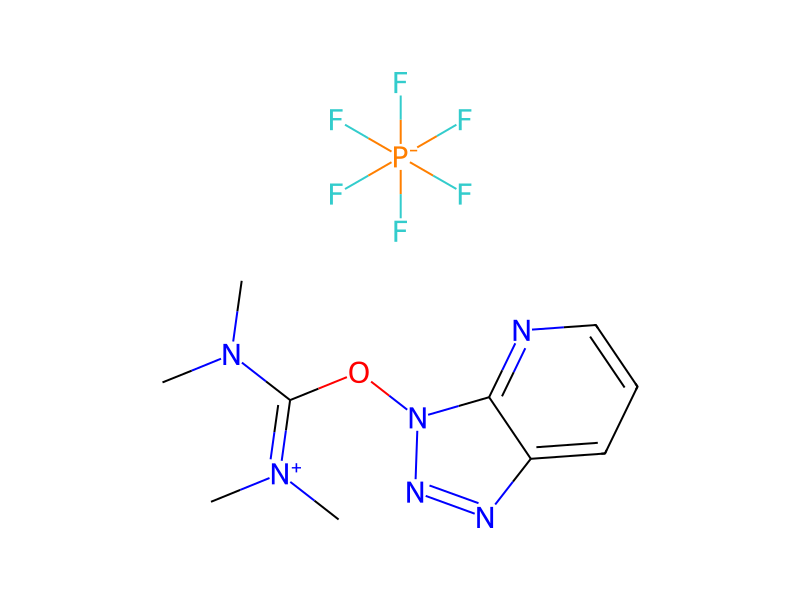 HCID 9886157Methanaminium, N-((dimethylamino)(3H-1,2,3-triazolo(4,5-b)pyridin-3-yloxy)methylene)-N-methyl-, hexafluorophosphate(1-) (1:1)
 HCID 672837722-(4-(4-Nitro-3-(trifluoromethyl)phenylamino)cyclohexyloxy)acetic acid
 HCID 867194671-(6-Fluoronaphthalen-2-yl)piperazine
Product 1

Reagents, catalysts & solvents 1

Procedure
To a solution of 2-[(4-[4-nitro-3-(trifluoromethyl)phenyl]aminocyclohexyl)-oxy]acetic acid (173 mg, 0.48 mmol, 1 eq) in dichloromethane (50 ml) was added DIEA (61.8 mg, 0.48 mmol, 1 eq), HATU (182 mg, 0.48 mmol, 1 eq) and 1-(6-fluoronaphthalen-2-yl)piperazine (110 mg, 0.48 mmol, 1 eq) at room temperature under an inert atmosphere of nitrogen. The resulting solution was stirred overnight. The reaction was then quenched by the addition of water (100 ml) and extracted with dichloromethane (3×50 ml) and the organic layers were combined and then dried over anhydrous sodium sulfate. The solids were filtered off. The resulting mixture was concentrated under vacuum to give a residue, which was applied onto a silica gel column and eluted with 2% methanol in dichloromethane. The product-containing fractions were combined and concentrated under vacuum to afford 1-[4-(6-fluoronaphthalen-2-yl)piperazin-1-yl]-2-[(4-[[4-nitro-3-(trifluoromethyl)phenyl]amino]cyclohexyl)oxy]ethan-1-one as a yellow solid (31.1 mg, 11%); (ES, m/z): [M−H]− 573.2; 1H NMR (300 MHz, DMSO/D2O): δ 8.05 (d, J=6.9 Hz, 1H), 7.77-7.82 (m, 2H), 7.53-7.56 (dd, J=1.8, 7.5 Hz, 1H), 7.43-7.46 (dd, J=1.5, 6.9 Hz, 1H), 7.28-7.33 (m, 1H), 7.25 (d, J=1.2 Hz, 1H), 7.06 (s, 1H), 6.83-6.86 (dd, J=1.8, 6.9 Hz, 1H), 4.21 (s, 2H), 3.63 (broad s, 4H), 3.37-3.52 (m, 2H), 3.21-3.26 (m, 4H), 1.94-2.05 (m, 4H), 1.34-1.39 (m, 2H), 1.23-1.29 (m, 2H).
Workup
- customThe reaction was then quenched by the addition of water (100 ml)
- extractionextracted with dichloromethane (3×50 ml)
- dry with materialdried over anhydrous sodium sulfate
- filtrationThe solids were filtered off
- concentrationThe resulting mixture was concentrated under vacuum
- customto give a residue, which
- washeluted with 2% methanol in dichloromethane
- concentrationconcentrated under vacuum
Sources & evidence
- ORD record
- ord-0742ac9c6f9043e3bdd6a50e04188d9e
- Source dataset
- uspto-grants-2016_02
- Patent number
- US09249102B2
Reaction notes
Loading…