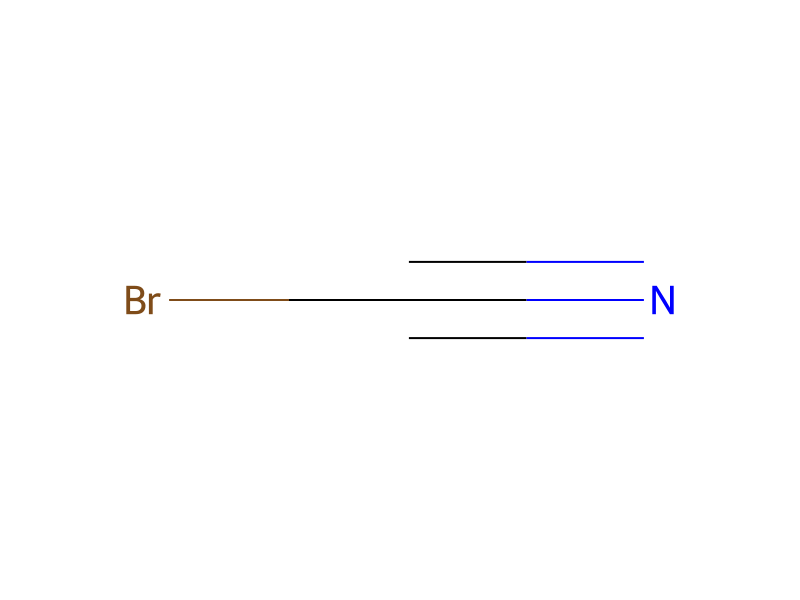
Cyanogen Bromide → tert-Butyl 4-cyanopiperazine-1-carboxylate
Reaction equation

[N:1]1([C:7]([O:9][C:10]([CH3:13])([CH3:12])[CH3:11])=[O:8])[CH2:6][CH2:5][NH:4][CH2:3][CH2:2]1.[CH:14]([N:17](CC)C(C)C)(C)C.N#CBr>ClCCl.O>[C:14]([N:4]1[CH2:5][CH2:6][N:1]([C:7]([O:9][C:10]([CH3:13])([CH3:12])[CH3:11])=[O:8])[CH2:2][CH2:3]1)#[N:17]Participants
6





Conditions
- Temperature
- 0 °C
Procedure
To a cooled (0° C.) solution of tert-butyl piperazine-1-carboxylate (1.517 g, 8.14 mmol) in dichloromethane (10 mL) were added N,N-diisopropylethylamine (1.54 mL, 9.00 mmol) and cyanogen bromide (911 mg, 8.60 mmol) and the reaction was stirred for 45 min at 0° C. The reaction mixture was warmed to room temperature, poured in water (100 mL) and extracted with EtOAc (100 mL). The organic layer was washed with water and brine, dried (Na2SO4) and concentrated under reduced pressure. The residue was washed twice with heptane and dried in vacuo, yielding 1.24 g (5.87 mmol, 72%) of a white solid that was used directly in the next step.
Workup
- temperatureThe reaction mixture was warmed to room temperature
- extractionextracted with EtOAc (100 mL)
- washThe organic layer was washed with water and brine
- dry with materialdried (Na2SO4)
- concentrationconcentrated under reduced pressure
- washThe residue was washed twice with heptane
- customdried in vacuo
Sources & evidence
- ORD record
- ord-10d2bbb675e84fa2b7f4c0f56f6b89ca
- Source dataset
- uspto-grants-2016_02
- Patent number
- US09260441B2
Reaction notes
Loading…