Dicyclohexylcarbodiimide → N,N'-Dicyclohexylurea
Reaction equation

C[C@@H]([C@@H]1[C@@]2(C)[C@@H](O)C[C@@H]3[C@@]4(C)CC[C@@H](O)C[C@H]4C[C@@H](O)[C@H]3[C@@H]2CC1)CCC(O)=[O:6].[CH2:30]1[CH2:35][CH2:34][CH:33]([N:36]=[C:37]=[N:38][CH:39]2[CH2:44][CH2:43][CH2:42][CH2:41][CH2:40]2)[CH2:32][CH2:31]1.ON1C(=O)CCC1=O>CN(C=O)C>[C:37]([NH:36][CH:33]1[CH2:32][CH2:31][CH2:30][CH2:35][CH2:34]1)([NH:38][CH:39]1[CH2:44][CH2:43][CH2:42][CH2:41][CH2:40]1)=[O:6]Participants
Reactant 3



Product 1
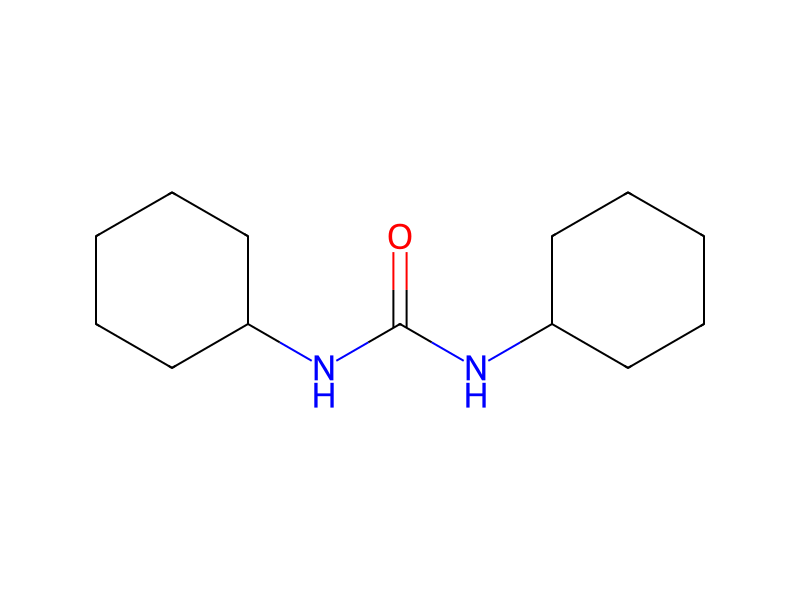
Reagents, catalysts & solvents 1

Procedure
To cholic acid (2 gm, 4.9 mmol) in anhydrous DMF (20 mL), under argon at room temperature, are added DCC (1 gm, 4.9 mmol) and N-hydroxysuccinimide (0.56 gm, 4.9 mmol). The reaction mixture is stirred at room temperature. Dicyclohexylurea starts forming after about 45 min. After 3.5 hours, the dicyclohexylurea is filtered, and the reaction mixture is concentrated under vacuum (using a vacuum pump) overnight to remove DMF. The residue is triturated with Et2O, and the precipitate is filtered. The precipitate is taken up in CH3CN, and the precipitate (left over dicyclohexylurea) is again filtered. Quantitative yield of product is obtained (2.5 gm). TLC (5% MeOH/EtOAc) Rf 0.26. 1HNMR (MeOH-d4): δ(ppm)=0.65 (s, 3H, 10axial CH3); 0.84 (s, 3H, 13axial CH3); 0.97 (d, 3H, CH3 on side chain); 2.78 (s, 4H, NHS protons).
Sources & evidence
- ORD record
- ord-88dc1cb9701e4347befeed9de659a51b
- Source dataset
- uspto-grants-1997_05
- Patent number
- US05627270
Reaction notes
Loading…