Phosphorus oxychloride → 4-[4-(4-Chloro-6,7-dihydrothieno[3,2-d]pyrimidin-2-yl)piperazin-1-yl]phenol
Reaction equation
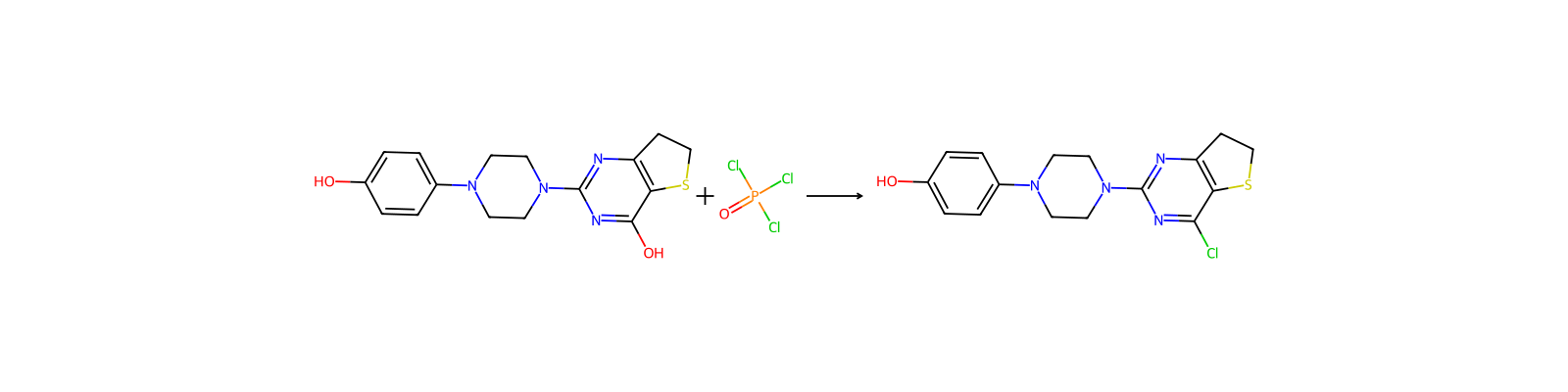
[OH:1][C:2]1[CH:7]=[CH:6][C:5]([N:8]2[CH2:13][CH2:12][N:11]([C:14]3[N:15]=[C:16](O)[C:17]4[S:22][CH2:21][CH2:20][C:18]=4[N:19]=3)[CH2:10][CH2:9]2)=[CH:4][CH:3]=1.P(Cl)(Cl)([Cl:26])=O>>[Cl:26][C:16]1[C:17]2[S:22][CH2:21][CH2:20][C:18]=2[N:19]=[C:14]([N:11]2[CH2:12][CH2:13][N:8]([C:5]3[CH:6]=[CH:7][C:2]([OH:1])=[CH:3][CH:4]=3)[CH2:9][CH2:10]2)[N:15]=1Participants
3



Conditions
- Temperature
- 120 °C
Procedure
1.11 g (3.36 mmol) of 2-[4-(4-hydroxyphenyl)piperazin-1-yl]-6,7-dihydrothieno[3,2-d]pyrimidin-4-ol (II) is placed in 5 mL of phosphorus oxychloride, then stirred for 4 hours at 120° C. Excess phosphorus oxychloride is then distilled off and the residue is combined with water. The precipitate formed is suction filtered, washed with plenty of water, and dried. 1.18 g of product III is obtained as a brown powder.
Workup
- distillationExcess phosphorus oxychloride is then distilled off
- customThe precipitate formed
- filtrationfiltered
- washwashed with plenty of water
- customdried
Sources & evidence
- ORD record
- ord-05d6277f9d5247f8bc3ff4a91822febd
- Source dataset
- uspto-grants-2009_03
- Patent number
- US07511045B2
Reaction notes
Loading…