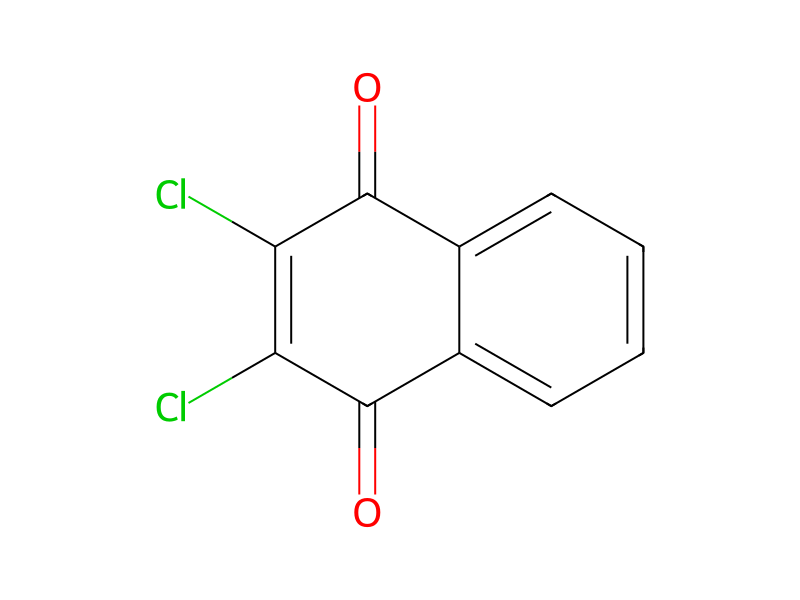
Dichlone → HCID 13934742, compound
Reaction equation

Cl[C:2]1[C:3](=[O:14])[C:4]2[C:9]([C:10](=[O:13])[C:11]=1[Cl:12])=[CH:8][CH:7]=[CH:6][CH:5]=2.[N:15]1([C:21]([O:23][CH2:24][CH3:25])=[O:22])[CH2:20][CH2:19][NH:18][CH2:17][CH2:16]1>C(O)C>[Cl:12][C:11]1[C:10](=[O:13])[C:9]2[C:4](=[CH:5][CH:6]=[CH:7][CH:8]=2)[C:3](=[O:14])[C:2]=1[N:18]1[CH2:17][CH2:16][N:15]([C:21]([O:23][CH2:24][CH3:25])=[O:22])[CH2:20][CH2:19]1Participants
4
Reactant 2

Product 1

Reagents, catalysts & solvents 1

Procedure
A mixture of 11.35 g of 2,3-dichloro-1,4-naphthoquinone, 15.8 g of 1-piperazinecarboxylic acid, ethyl ester and 400 ml of absolute ethanol was heated at reflux for 3 hours and then evaporated to dryness. The residue was taken up in 300 ml of dichloromethane and filtered through silica gel. The filtrate was evaporated and the residue triturated with ether, giving 8.0 g of the desired product as red crystals, mp 120°-122° C.
Workup
- temperaturewas heated
- temperatureat reflux for 3 hours
- customevaporated to dryness
- filtrationfiltered through silica gel
- customThe filtrate was evaporated
- customthe residue triturated with ether
Sources & evidence
- ORD record
- ord-5e5ab1b93bec4eba8877cca84ee8b3fb
- Source dataset
- uspto-grants-1987_08
- Patent number
- US04686220
Reaction notes
Loading…