Ethyl vinyl ether → 2-Bromo-2-(4-nitrophenyl)acetaldehyde
Reaction equation

[Br:1]C1C=CC([N+]([O-])=O)=CC=1.C(OCC)=C.C(N(CC)CC)C.C([O:25][CH:26]=[CH:27][C:28]1[CH:33]=[CH:32][C:31]([N+:34]([O-:36])=[O:35])=[CH:30][CH:29]=1)C.BrBr.C(=O)(O)[O-].[Na+]>C(OCC)C.C([O-])(=O)C.[Pb+2].C([O-])(=O)C.C1(C)C=CC=CC=1P(C1C=CC=CC=1C)C1C=CC=CC=1C.O>[Br:1][CH:27]([C:28]1[CH:33]=[CH:32][C:31]([N+:34]([O-:36])=[O:35])=[CH:30][CH:29]=1)[CH:26]=[O:25]Participants
Reactant 6
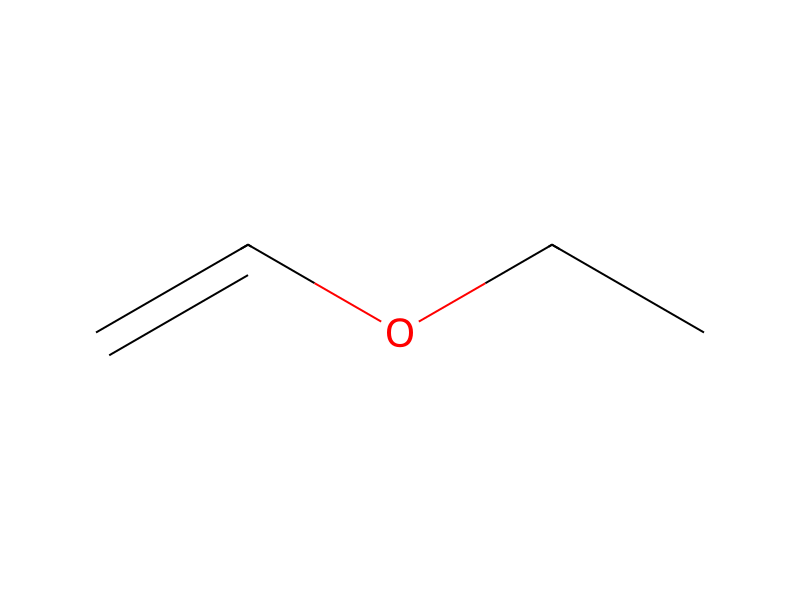





Product 1

Reagents, catalysts & solvents 4




Procedure
A mixture of 16.0 g (80 mmole) of 1-bromo-4-nitrobenzene, 11.2 ml (ca. 120 mmole) of ethyl vinyl ether, 179.2 mg of lead(II) acetate, 484 mg of tri-o-tolylphosphine, and 22 ml (ca. 160 mmole) of triethylamine was placed in a bomb, purged with nitrogen, and heated at 100° for eight hours. The reaction mixture was partitioned between diethyl ether and water and clarified by filtration. The organic layer was washed with water, dried over magnesium sulfate, filtered, and concentrated in vacuo. Chromatography of the residue on silica gel (using toluene-hexane as eluant) yielded three principle components (in order of elution): 2.1 g of 4-(1-ethoxyvinyl)nitrobenzene, 3.0 g of the cis isomer of 4-(2-ethoxyviny)nitrobenzene, and 7.2 g of the trans isomer of 4-(2-ethoxyvinyl)nitrobenzene. A solution of 3.0 g (15 mmole) of 4-(2-ethoxyvinyl)nitrobenzene (as a mixture of cis and trans isomers) in 30 ml of diethyl ether was cooled to - 15°. Bromine (2.48 ml, ca. 15 mmole) was added dropwise as the temperature was maintained at or below -10°. The reaction mixture was poured into 50 ml of water containing 5 g of sodium bicarbonate. After two hours of stirring, the mixture was allowed to separate into layers. The organic layer was washed with water, dried over sodium sulfate, filtered, and concentrated in vacuo to yield 3.9 g of 2-bromo-2-(4-nitrophenyl)acetaldehyde as an oil. A mixture of 1.98 g (15 mmole) of 3-hydroxymethyl-2-pyridinamine and 3.9 g (15 mmole) of 2-bromo-2-(4-nitrophenyl)acetaldehyde was warmed to initiate an exothermic reactiion. After cooling, the mixture was shaken with aqueous potassium carbonate and dichloromethane. The solid was collected, washed with water and dichloromethane, and air dried to yield 2.84 g of 8-hydroxymethyl-2-(4-nitrophenyl)imidazo[1,2-a]pyridine, as confirmed by the nmr and infrared spectra. The title compound (100 mg) was prepared by the method described in Example 6 using 1.4 g (5.2 mmole) of 8-hydroxymethyl-2-(4-nitrophenyl)imidazo[1,2-a]pyridine instead of 8-hydroxymethylimidazo[1,2-a]pyridine. Structure assignment was supported by the nmr and infrared spectra and by elemental analysis.
Workup
- custompurged with nitrogen
- temperatureheated at 100° for eight hours
- customThe reaction mixture was partitioned between diethyl ether and water
- filtrationclarified by filtration
- washThe organic layer was washed with water
- dry with materialdried over magnesium sulfate
- filtrationfiltered
- concentrationconcentrated in vacuo
- customChromatography of the residue on silica gel (using toluene-hexane as eluant) yielded
- washthree principle components (in order of elution)
- temperaturewas cooled to - 15°
- temperaturewas maintained at or below -10°
- customto separate into layers
- washThe organic layer was washed with water
- dry with materialdried over sodium sulfate
- filtrationfiltered
- concentrationconcentrated in vacuo
Sources & evidence
- ORD record
- ord-a780a0ca91834f50975115462cbc9747
- Source dataset
- uspto-grants-1987_08
- Patent number
- US04687775
Reaction notes
Loading…