Isoquinoline → 2-(3-Methylbutyl)isoquinolin-2-ium iodide
Reaction equation

[CH2:1]([I:6])[CH2:2][CH:3]([CH3:5])[CH3:4].[CH:7]1[C:16]2[C:11](=[CH:12][CH:13]=[CH:14][CH:15]=2)[CH:10]=[CH:9][N:8]=1>C(O)C>[I-:6].[CH2:1]([N+:8]1[CH:9]=[CH:10][C:11]2[C:16](=[CH:15][CH:14]=[CH:13][CH:12]=2)[CH:7]=1)[CH2:2][CH:3]([CH3:5])[CH3:4]Participants
Reactant 2
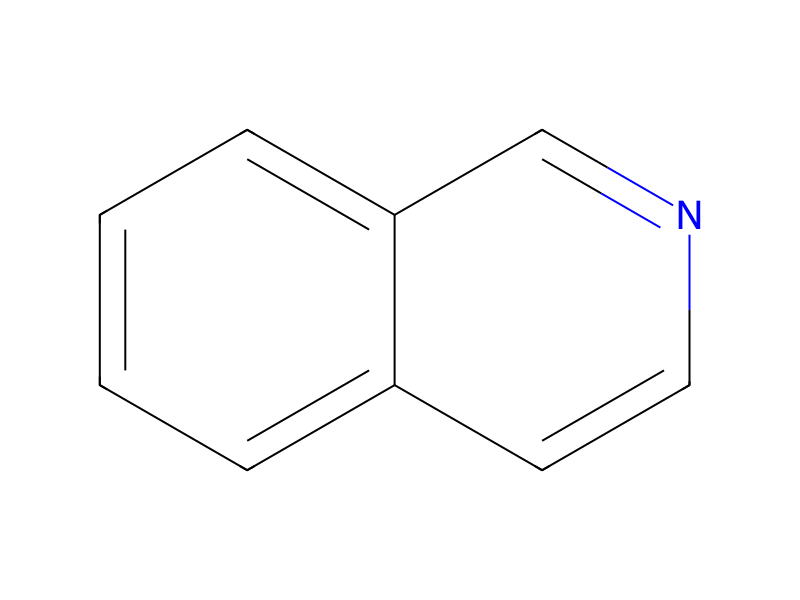

Product 1

Reagents, catalysts & solvents 1

Procedure
To 15.3 g of isoamyliodide and 10 g of isoquinoline placed in a four-necked flask equipped with a reflux condenser and mechanical stirrer was added 30 ml of ethanol. The mixture was reacted for 3 hours under reflux. When the reaction was completed, ethanol was removed from the reaction mixture under reduced pressure, the residue was washed 2-times with 45 ml of ethyl ether. 23.0 g of N-isoamylisoquinolinium iodide was obtained as yellow crystals. Subsequently, into a four-necked flask equipped with a reflux condenser and mechanical stirrer was placed 8 g of TCNQ and 280 ml of acetonitrile, and the TCNQ was dissolved in the acetonitrile under reflux. To the flask was added a solution of 9.6 g of N-isoamylisoquinolinium iodide in 40 ml of acetonitrile, and the mixture was reacted for 20 minutes under reflux. The reaction mixture was cooled to 5° C., separated black needles were filtered out and washed 2-times with 100 ml of methanol. 10.4 g of charge transfer complex of N-isoamylisoquinolinium TCNQ was obtained. The infra-red spectrum of the complex was shown in FIG. 3. The specific resistance of the complex measured by the same method as that described in Example 1 was 3.6 Ωcm.
Workup
- customequipped with a reflux condenser and mechanical stirrer
- customThe mixture was reacted for 3 hours
- temperatureunder reflux
- customethanol was removed from the reaction mixture under reduced pressure
- washthe residue was washed
Sources & evidence
- ORD record
- ord-97027fce6f1e4875ac3ae1510fc2b45f
- Source dataset
- uspto-grants-1987_08
- Patent number
- US04688153
Reaction notes
Loading…