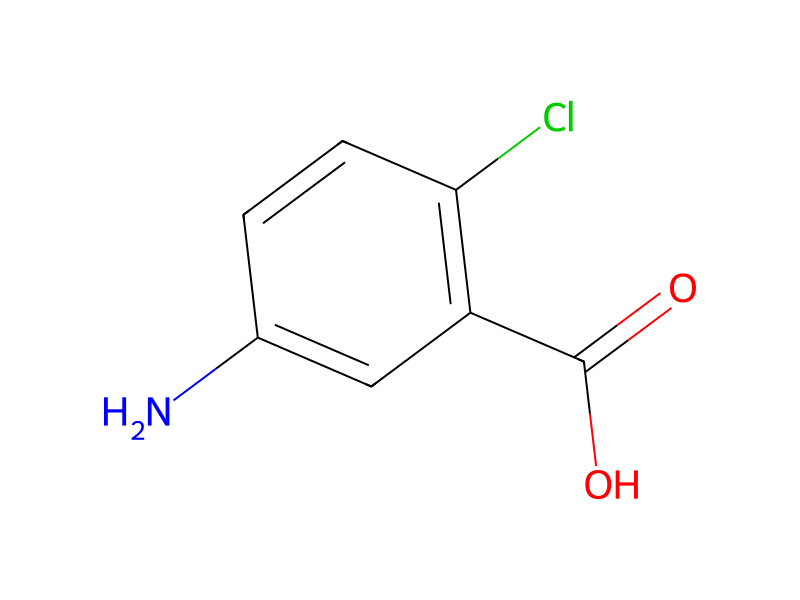
5-Amino-2-chlorobenzoic acid → HCID 22041791, compound
Reaction equation

[NH2:1][C:2]1[CH:3]=[CH:4][C:5]([Cl:11])=[C:6]([CH:10]=1)[C:7]([OH:9])=[O:8].Cl[S:13]([C:16]1[CH:25]=[C:24]2[C:19]([CH:20]=[CH:21][C:22]([NH:26][C:27](=[O:29])[CH3:28])=[CH:23]2)=[CH:18][CH:17]=1)(=[O:15])=[O:14]>C1COCC1.N1C=CC=CC=1>[C:27]([NH:26][C:22]1[CH:23]=[C:24]2[C:19]([CH:18]=[CH:17][C:16]([S:13]([NH:1][C:2]3[CH:3]=[CH:4][C:5]([Cl:11])=[C:6]([CH:10]=3)[C:7]([OH:9])=[O:8])(=[O:15])=[O:14])=[CH:25]2)=[CH:20][CH:21]=1)(=[O:29])[CH3:28]Participants
Reactant 2

Product 1

Reagents, catalysts & solvents 2


Conditions
- Temperature
- 5 °C
Procedure
To 15 g (0.087 mol) of 5-amino-2-chlorobenzoic acid was dissolved in 450 mL of THF and 15 mL of pyridine. The solution was cooled to 5° C. in an ice-water bath. Then, a solution of 20.8 g (0.074 mol) of compound 131 dissolved in 200 mL of THF was added over a 10 min period. The reaction was kept at 5° C. for 30 min, and then allowed to warm to room temperature. The reaction was allowed to stir for an additional 4 hours. Then, the reaction was filtered to remove some insoluble material and the resulting clear filtrate was reduced to a solid by the removal of the volatiles by rotary evaporation. This solid was extracted with ethyl acetate and 1 N HCl. The ethyl acetate layer was further extracted with 0.5 M NaOH (once) and 0.33 M NaOH (three times). The aqueous layers were combined, acidified with HCl, and back extracted into ethyl acetate. After drying (MgSO4), filtration, and removal of the ethyl acetate by rotary evaporation, the solid residue was dissolved in 2.8 L of 50/50 methanol/water with heating. The solution was allowed to cool to room temperature and a small amount of solid was removed by vacuum filtration and discarded. The clear filtrate was allowed to sit for 48 hours and then was reduced in volume to about 500 mL by rotary evaporation. The solid was collected by vacuum filtration. After drying in vacuo, this provided 17.6 g of compound 132.
Workup
- additionwas added over a 10 min period
- temperatureto warm to room temperature
- filtrationThen, the reaction was filtered
- customto remove some insoluble material
- customthe resulting clear filtrate was reduced to a solid by the removal of the volatiles by rotary evaporation
- extractionThis solid was extracted with ethyl acetate and 1 N HCl
- extractionThe ethyl acetate layer was further extracted with 0.5 M NaOH (once) and 0.33 M NaOH (three times)
- extractionback extracted into ethyl acetate
- customAfter drying
- filtration(MgSO4), filtration, and removal of the ethyl acetate
- customby rotary evaporation
- dissolutionthe solid residue was dissolved in 2.8 L of 50/50 methanol/water
- temperaturewith heating
- temperatureto cool to room temperature
- customa small amount of solid was removed by vacuum filtration
- waitto sit for 48 hours
- customwas reduced in volume to about 500 mL by rotary evaporation
- filtrationThe solid was collected by vacuum filtration
- customAfter drying in vacuo
Sources & evidence
- ORD record
- ord-48b67bb86430442891c6a781a03a2169
- Source dataset
- uspto-grants-2006_07
- Patent number
- US07071231B2
Reaction notes
Loading…