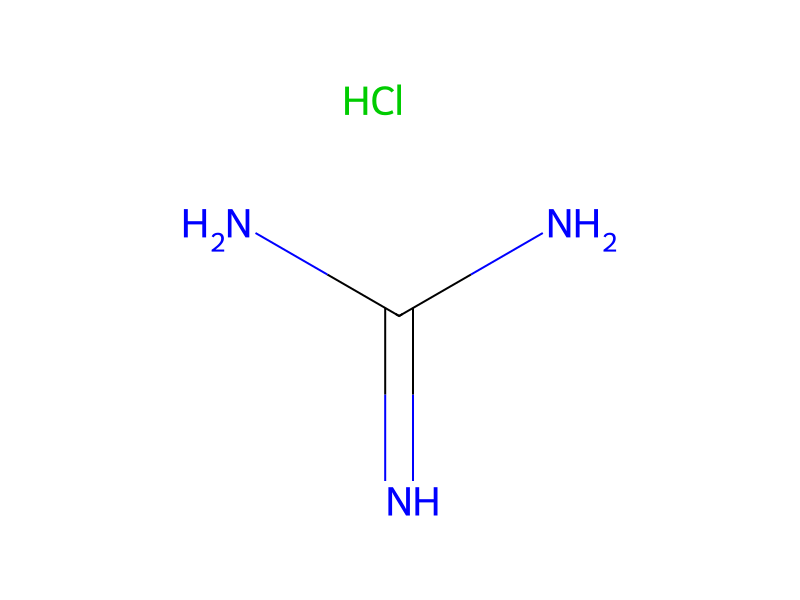
Guanidine Hydrochloride → HCID 178429891, compound
Reaction equation

Cl.[NH2:2][C:3]([NH2:5])=[NH:4].C[O-].[Na+].Cl.[Cl:10][C:11]([C:13]1[C:17]([CH3:18])=[CH:16][N:15]([C:19]2[CH:28]=[CH:27][CH:26]=[C:25]3[C:20]=2[CH:21]=[CH:22][CH:23]=[N:24]3)[CH:14]=1)=[O:12]>CO>[ClH:10].[NH:4]([C:11]([C:13]1[C:17]([CH3:18])=[CH:16][N:15]([C:19]2[CH:28]=[CH:27][CH:26]=[C:25]3[C:20]=2[CH:21]=[CH:22][CH:23]=[N:24]3)[CH:14]=1)=[O:12])[C:3]([NH2:5])=[NH:2]Participants
Reactant 3


Product 1

Reagents, catalysts & solvents 1

Procedure
1.06 g (11.18 mmol) of guanidine hydrochloride is added to a solution of 0.604 g (11.18 mmol) of sodium methoxide in 50 mL of methanol at a temperature in the region of 20° C. under an argon atmosphere. After stirring for 2 hours at this temperature, the mixture is concentrated to dryness under reduced pressure (2.7 kPa). The residue is taken up in 25 mL of 1,2-dimethoxyethane, and 0.57 g (1.86 mmol) of 3-chlorocarbonyl-4-methyl-1-(quinolin-5-yl)-1H-pyrrole hydrochloride is added. After stirring for 2 hours at a temperature in the region of 20° C., the reaction mixture is concentrated to dryness under reduced pressure (2.7 kPa). The residue is triturated in 25 mL of water and then filtered, giving a gum, which is triturated again in 20 mL of water and filtered. The residue is purified by chromatography on silica gel [eluent: chloroform/methanol (80/20 by volume)]. After the fractions containing the expected product have been concentrated to dryness under reduced pressure, the residue is dissolved in ethyl acetate, and excess 4 M hydrochloric ether is added. After the reaction mixture has been stirred at room temperature for one hour, the precipitate formed is isolated by filtration, giving 0.25 g of 3-guanidinocarbonyl-4-methyl-1-(quinolin-5-yl)-1H-pyrrole hydrochloride in the form of a yellow solid melting at 240° C. Mass spectrum (EI): m/e 293 (M+.) (base peak).
Workup
- concentrationthe mixture is concentrated to dryness under reduced pressure (2.7 kPa)
- stirringAfter stirring for 2 hours at a temperature in the region of 20° C.
- concentrationthe reaction mixture is concentrated to dryness under reduced pressure (2.7 kPa)
- customThe residue is triturated in 25 mL of water
- filtrationfiltered
- customgiving a gum, which
- customis triturated again in 20 mL of water
- filtrationfiltered
- customThe residue is purified by chromatography on silica gel [eluent: chloroform/methanol (80/20 by volume)]
- additionAfter the fractions containing the expected product
- concentrationhave been concentrated to dryness under reduced pressure
- dissolutionthe residue is dissolved in ethyl acetate
- additionexcess 4 M hydrochloric ether is added
- stirringAfter the reaction mixture has been stirred at room temperature for one hour
- customthe precipitate formed
- customis isolated by filtration
Sources & evidence
- ORD record
- ord-7dbe4b69649d42f4930f731530a40827
- Source dataset
- uspto-grants-2006_07
- Patent number
- US07078414B2
Reaction notes
Loading…