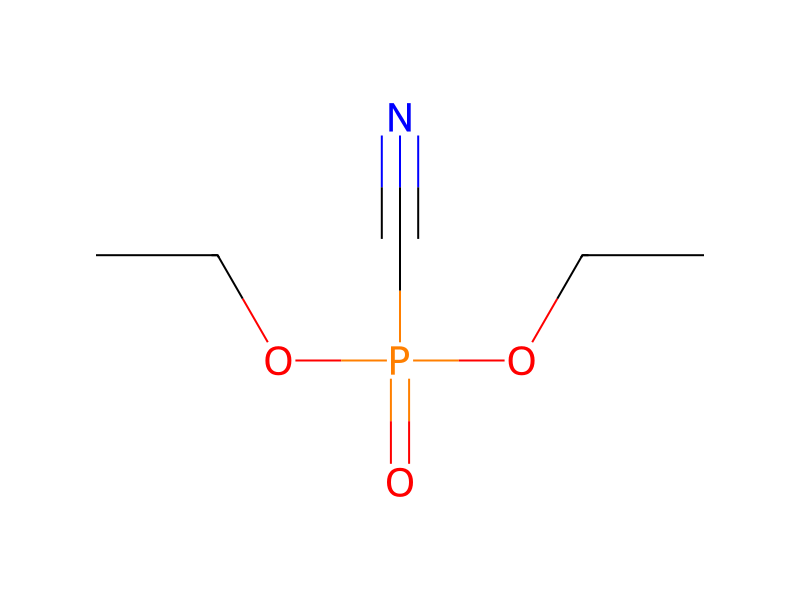
Pyrophosphate → Diethyl cyanophosphonate
Reaction equation

[P:1]([O-:12])([O:7][C:8](C)(C)[CH3:9])[O:2][C:3](C)(C)[CH3:4].[CH:13]([N:16](C(C)C)P(Cl)(N)=O)(C)C.[O-]P(OP([O-])([O-])=O)(=O)[O-].C(OP([O-])(OCC1C=CC=CC=1)=O)C1C=CC=CC=1>>[CH2:3]([O:2][P:1]([C:13]#[N:16])(=[O:12])[O:7][CH2:8][CH3:9])[CH3:4]Participants


Procedure
In order to try different protecting groups on the phosphate, several other methods of phosphorylation were attempted. These included the use of alkylamidophosphines, which have been shown to readily phosphorylate alcohols and phenols in high yield. For example, di-tert-butyloxy (N,N-diisopropylamido)phosphine, prepared from dichloro(N,N-diisopropylamido)phosphine and tert-butanol was allowed to react with diphenol 1 in the presence of 1H-tetrazole. After phosphorylating diphenol 1, subsequent in situ oxidation of the trivalent phosphorous to the pentavalent species with meta-chloroperoxybenzoic acid did not result in the desired phosphate. Perhaps this unpromising result arose from the steric crowding involved with four tert-butyl groups in the 2′- and 3′- positions, or from the oxidation step which may have effected the stilbene olefin. Interestingly, the use of dibenzyloxy(N,N-diisopropylamido)phosphine under the reaction conditions just described did afford phosphate 10 but only in 10% yield. Two other phosphorylation methods were attempted using di-tert-butyl phosphite with an in situ generation of the appropriate halide (Br, Cl), and N,N-diisopropylphosphorodiamidic chloride. Neither method led to the corresponding diphosphate analog of dibenzylphosphate 10. Diphosphorylation of 1 was also achieved in good yield with diethylcyano-phosphonate. However, this method proved to be problematic due to harsh conditions needed to remove an ethyl group.
Sources & evidence
- ORD record
- ord-e258e6a24542474ba0381f930f986120
- Source dataset
- uspto-grants-2006_07
- Patent number
- US07078552B2
Reaction notes
Loading…