m-Chloroperbenzoic acid → 3-Chlorobenzoic Acid
Reaction equation

[CH:1]1[CH:6]=[C:5]([Cl:7])[CH:4]=[C:3]([C:8]([O:10]O)=[O:9])[CH:2]=1>C(Cl)Cl>[Cl:7][C:5]1[CH:4]=[C:3]([C:8]([OH:10])=[O:9])[CH:2]=[CH:1][CH:6]=1Participants
Reactant 1

Product 1
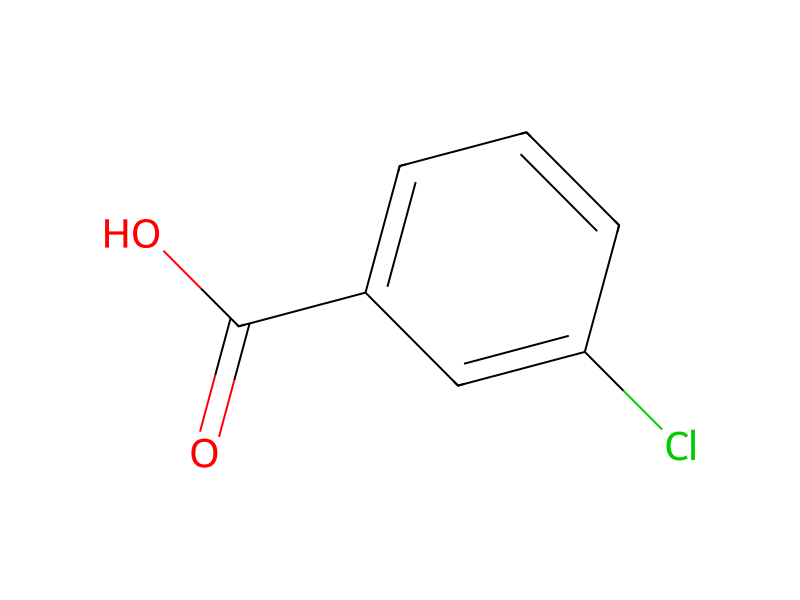
Reagents, catalysts & solvents 1

Procedure
m-CPBA (8 g, 35.70 mmol based on 77% purity) was dried in vacuum until vacuum reached 10 mTorr. Anhydrous methylene chloride (100 mL) was added to dissolve m-CPBA. The solution of Me2Si(CH═CH2)2 (2 g, 17.86 mmol) in CH2Cl2 was added to the clear solution of m-CPBA in CH2Cl2. No visual changes occurred. The reaction mixture was left stirring overnight. White precipitate of m-ClC6H4COOH formed by next morning. The mixture was reduced in volume under vacuum (about 80 mL of CH2Cl2 were removed). Pentane (50 mL) was added and then the mixture was filtered. Low boiling point volatiles were removed in vacuum. The mixture of Me2Si(CH═CH2)(CHCH2O) (15%) and the product (85%) was isolated using nitrogen trap under high vacuum. Yield: 50%. Boiling point: 45° C. at 0.2 Torr. Mass spectrum: (EI, %): m/z 101 (M+−CHCH2O, 20), 59 (Me2SiH, 100). 1H NMR (C6D6): δ 2.58–2.54 (m, 2H, SiCHCHHO), 2.38–2.28 (m, 2H, SiCHCHHO), 2.04–1.98 (m, 2H, SiCHH2O), −0.10 and −0.12 (m, 6H, SiCH3). 13C NMR: (C6D6). δ 44.27 and 44.19 (SiCHCH2O), 41.70 and 41.43 (SiCHCH2O), −7.36, −7.50 and −7.74 (SiCH3). The complicate NMR spectra are consistent with four stereoisomerisms possible for Me2Si(C*HCH2O)2. Two diastereomers in the ratio of 1:1 were separated by GC/MS.
Workup
- waitThe reaction mixture was left
Sources & evidence
- ORD record
- ord-905e150b3b26483d87aad67486a9f562
- Source dataset
- uspto-grants-2006_04
- Patent number
- US07022864B2
Reaction notes
Loading…