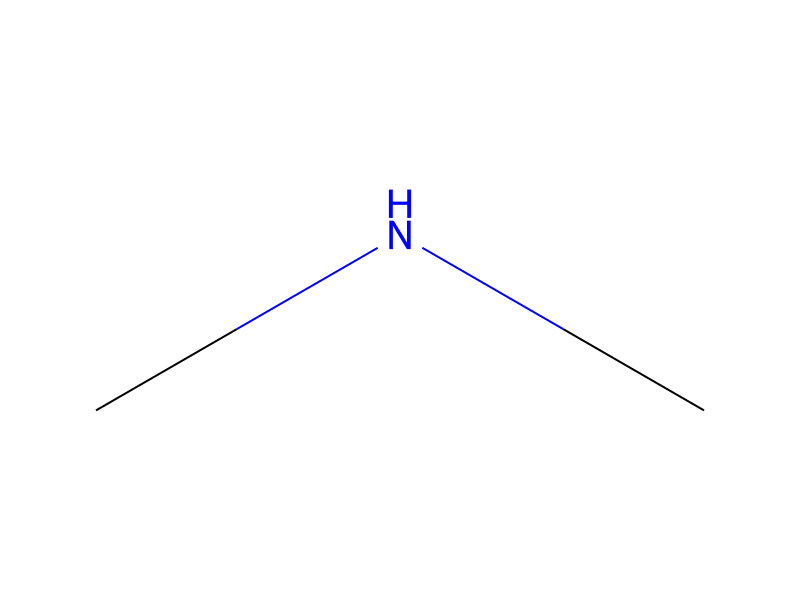
Dimethylamine → HCID 23533341, compound
Reaction equation

[N:1]1([C:7]2[CH:12]=[CH:11][C:10]([NH:13][C:14]([C:16]3[CH:25]=[C:24](Cl)[C:23]4[C:18](=[C:19]([Br:29])[CH:20]=[C:21]([O:27][CH3:28])[CH:22]=4)[N:17]=3)=[O:15])=[CH:9][CH:8]=2)[CH2:6][CH2:5][O:4][CH2:3][CH2:2]1.[CH3:30][NH:31][CH3:32]>O1CCCC1>[N:1]1([C:7]2[CH:12]=[CH:11][C:10]([NH:13][C:14]([C:16]3[CH:25]=[C:24]([N:31]([CH3:32])[CH3:30])[C:23]4[C:18](=[C:19]([Br:29])[CH:20]=[C:21]([O:27][CH3:28])[CH:22]=4)[N:17]=3)=[O:15])=[CH:9][CH:8]=2)[CH2:6][CH2:5][O:4][CH2:3][CH2:2]1Participants
Reactant 2

Product 1

Reagents, catalysts & solvents 1

Procedure
A solution of 8-bromo-4-chloro-6-methoxy-quinoline-2-carboxylic acid (4-morpholin-4-yl-phenyl)-amide (Reference Example 28a) (0.1512 g, 0.317 mmol) in 100 mL 2.0 M dimethyl amine in tetrahydrofuran was heated at 100° C. in a Parr bomb. The initial pressure was 75–80 psi and then remained at approximately 60 psi. After 18 hours, the reaction was cooled to room temperature, concentrated and dried to afford the crude product as a brown solid. Purification on silica gel using a gradient of 100:0 to 95:5 methylene chloride:methanol afforded the clean product (0.142 g; 92%). 1H NMR (300 MHz, DMSO, d6) δ 10.20 (s, 1 H, C(O)NH), 7.90 (d, 1 H, Jm=2.7 Hz, ArH5), 7.69 (d, 2 H, Jo=9.0 Hz, ArH2′ & H6′), 7.60 (s, 1 H, ArH3), 7.41 (d, 1 H, Jm=2.7 Hz, ArH7), 7.01 (d, 2 H, Jo=9.0 Hz, ArH3′ & H5′), 3.96 (s, 3 H, OCH3), 3.75 (t, 4 H, J=4.8 Hz, OCH2CH2N), 3.10 (t, 4 H, J=4.8 Hz, OCH2CH2N), 3.08 (s, 6 H, N(CH3)2); Mass Spec.: calc. for [C21H19BrClN3O3+H]+ Theor. m/z=485, 487; Obs.=485, 487
Workup
- concentrationconcentrated
- customdried
- customto afford the crude product as a brown solid
- customPurification on silica gel using a gradient of 100:0 to 95:5 methylene chloride
- custommethanol afforded the clean product (0.142 g; 92%)
Sources & evidence
- ORD record
- ord-fa54ba1731204a64955579b4488a248b
- Source dataset
- uspto-grants-2006_04
- Patent number
- US07026314B2
Reaction notes
Loading…