Sulfuric Acid → Naphthalene
Reaction equation

[CH:1]1[C:14]2[C:5](=[CH:6][C:7]3[C:12]([CH:13]=2)=CC=CC=3)[CH:4]=[CH:3][CH:2]=1.S(=O)(=O)(O)O>O>[CH:13]1[C:14]2[C:5](=[CH:4][CH:3]=[CH:2][CH:1]=2)[CH:6]=[CH:7][CH:12]=1Participants
Reactant 2

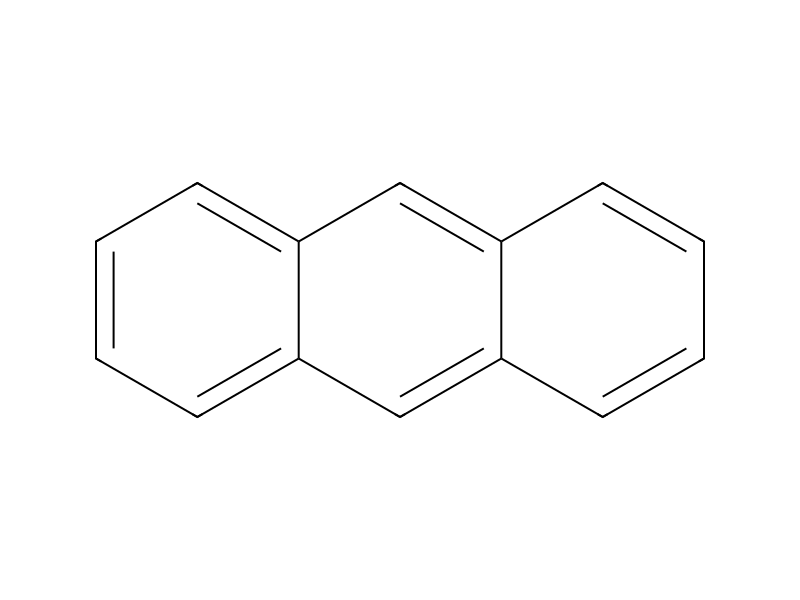
Product 1

Reagents, catalysts & solvents 1

Conditions
- Temperature
- 140 °C
Procedure
534 gms of anthracene and 326 ml of concentrated sulfuric acid were added to a 2 liter round bottom flask fitted with a stirrer. The contents of the flask were heated to 140° C. for 90 minutes with continuous stirring. 1 ml of the mass was placed in a beaker and 3 ml water was added with shaking. It was observed to form a clear solution without a free naphthalene smell, confirming the completion of sulfonation. The sulfonated mass was transferred to a reactor fitted with a thermometer, stirrer and a dropping funnel. The mass was stirred continuously for a period of 10 min. while maintaining the temperature at 80° C. A mixture of 5.4 gms oxalic acid, 4.14 gms salicylic acid and 10 gms phthalic acid dissolved in 50 ml water was added to the above sulfonated mass and stirring was continued at 80° C. 1.5 gms of polymethacrylic acid was added to the sulphonic acid mixture and the mixture was heated to 80° C. for 1 hour. A small portion of the reaction mixture was transferred to a beaker and 2 ml water was added to the mass. The pH of the solution in the beaker was adjusted to 3 and a clear solution was obtained, indicating the completion of the reaction. About 540 ml of water was added to the mass and transferred to a bucket after cooling the reaction mass to room temperature. The pH of the mass was raised to 3 by adding a solution of 220 gms of sodium hydroxide in 500 ml water, followed by the addition of an aqueous solution of 200 gms of sodium carbonate in 400 ml water. The slurry was aerated for 45 minutes conventionally and filtered using a cloth of pore size 5–10μ. The filtrate was spray dried at 260° C. and the white powder obtained was stored in a plastic container. The prepared syntan was added to delimed sheepskins at 1.0% w/w (weight of syntan to weight of pelt) along with 5% basic chrominum sulfate (BCS) w/w (weight of BCS to weight of pelt) at a float of 20% v/w (volume of water to weight of pelt) in a small tanning drum. The drum was run for 1 hr and 80% water v/w (volume of water to weight of pelt) was added. The drum was run for another 1 hr and penetration of the tanning chemicals into the skins was assessed by checking uniform blue color along a cut section. The pH of the solution and the cut section was found to be 4.4. The bath was drained and the wet blue leathers were piled. On the next day, the leathers were post-tanned using a conventional garment leather processing recipe. The chromium exhaustion of the spent tan liquor was found to be 95%. The fullness of the crust leathers was found to be superior to that of conventional chrome tanned leathers.
Workup
- customfitted with a stirrer
- additionwas added
Sources & evidence
- ORD record
- ord-f762a27730c9439fa8c606280e26b0a3
- Source dataset
- uspto-grants-2006_04
- Patent number
- US07033402B2
Reaction notes
Loading…