Hydrochloric Acid → HCID 67050742, compound
Reaction equation

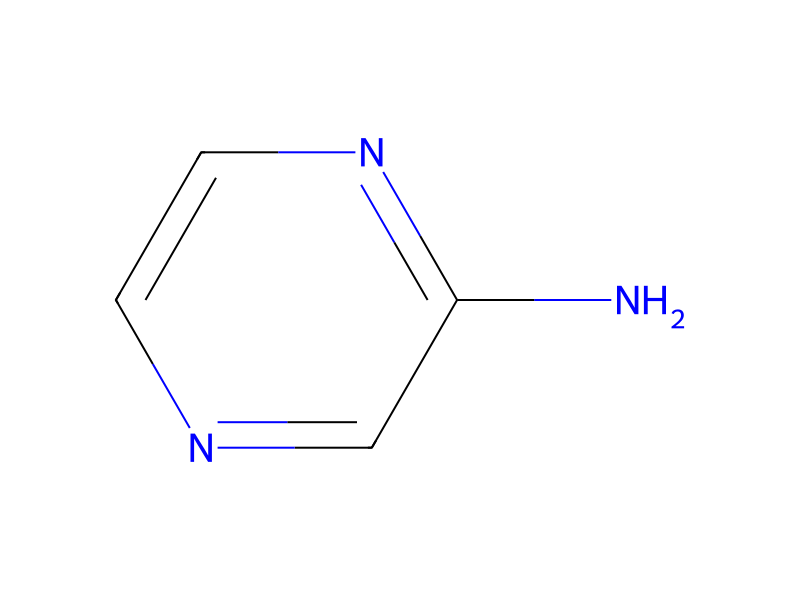
Cl.[NH2:2][C:3]1[CH:8]=[N:7][CH:6]=[CH:5][N:4]=1.[F:9][C:10]([F:34])([F:33])[CH2:11][N:12]1[C:16]([C:17]2[CH:18]=[C:19]3[N:25]([N:26]=2)[C:24]2[CH:27]=[C:28]([CH:31]=O)[CH:29]=[CH:30][C:23]=2[O:22][CH2:21][CH2:20]3)=[N:15][CH:14]=[N:13]1>C(OCC)C>[F:33][C:10]([F:9])([F:34])[CH2:11][N:12]1[C:16]([C:17]2[CH:18]=[C:19]3[N:25]([C:24]4[CH:27]=[C:28]([CH2:31][NH:2][C:3]5[CH:8]=[N:7][CH:6]=[CH:5][N:4]=5)[CH:29]=[CH:30][C:23]=4[O:22][CH2:21][CH2:20]3)[N:26]=2)=[N:15][CH:14]=[N:13]1Participants
5
Reactant 3


Product 1

Reagents, catalysts & solvents 1

Procedure
Following the procedure for 128 without the use of HCl in diethyl ether, 2-[2-(2,2,2-trifluoro-ethyl)-2H-[1,2,4]triazol-3-yl]-4,5-dihydro-6-oxa-1,10b-diaza-benzo[e]azulene-9-carbaldehyde was reacted with 2-amino pyrazine to give 131 as a white solid. 1H NMR (CDCl3, 400 MHz): δ 8.03-7.99 (m, 3H); 7.87 (d, J=2.6 Hz, 1H); 7.84 (d, J=2.2 Hz, 1H); 7.31 (dd, J=8.3, 2.2 Hz, 1H); 7.20 (d, J=8.3 Hz, 1H); 6.92 (s, 1H); 5.49 (q, J=8.2 Hz, 2H); 5.42 (br s, 1H); 4.66 (d, J=5.4 Hz, 2H); 4.55 (t, J=6.0 Hz, 2H); 3.16 (t, J=6.0 Hz, 2H). LCMS: RT=9.93 min, M+H+=443
Sources & evidence
- ORD record
- ord-4b0fa6f0344e429e8252bbace2f3d4d2
- Source dataset
- uspto-grants-2013_01
- Patent number
- US08343955B2
Reaction notes
Loading…