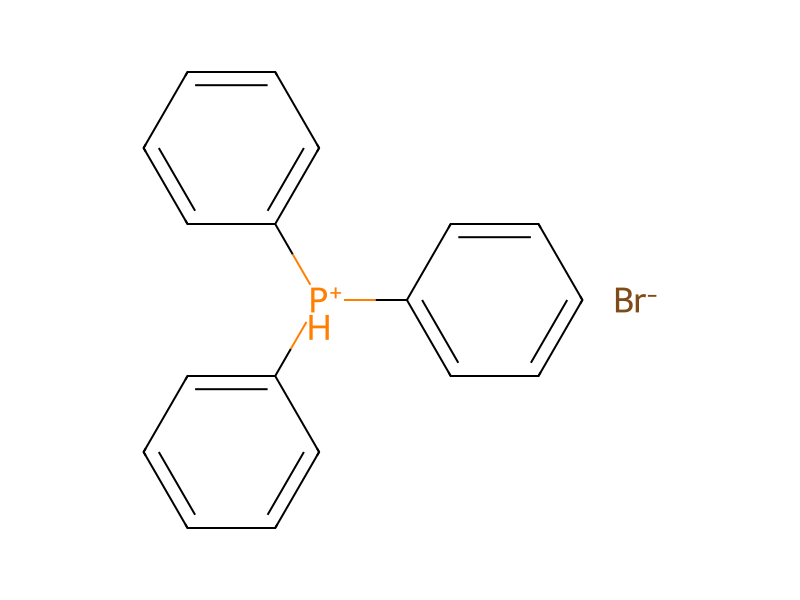
Triphenylphosphine → Phosphine, triphenyl-, hydrobromide
Reaction equation

[C:1]1([P:7]([C:14]2[CH:19]=[CH:18][CH:17]=[CH:16][CH:15]=2)[C:8]2[CH:13]=[CH:12][CH:11]=[CH:10][CH:9]=2)[CH:6]=[CH:5][CH:4]=[CH:3][CH:2]=1.C(OC(=O)C(C)(C)CCCCC[Br:30])C>C1(C)C=CC=CC=1>[Br-:30].[C:14]1([PH+:7]([C:1]2[CH:2]=[CH:3][CH:4]=[CH:5][CH:6]=2)[C:8]2[CH:13]=[CH:12][CH:11]=[CH:10][CH:9]=2)[CH:15]=[CH:16][CH:17]=[CH:18][CH:19]=1Participants
Reactant 2


Product 1
Reagents, catalysts & solvents 1

Conditions
- Temperature
- 122 °C
Procedure
Triphenylphosphine (14.8 g, 56.6 mmoL) was added to a solution of 7-bromo-2,2-dimethylheptanoic acid ethyl ester (15.0 g, 56.6 mmoL) in toluene (110 mL). The solution was heated to reflux (oil bath 122° C.) for 24 h. The toluene was evaporated and the residue was washed with heptane (2×60 mL), diethyl ether (2×60 mL), and dried in high vacuum to a constant weight to provide 6-ethoxycarbonyl-6-methylheptyl)triphenylphosphonium bromide (24.39 g, 81.8% yield) as a off-white powder (m.p. 165-170° C.). 1H NMR (Field: 300 MHz, Solvent: CDCl3/TMS) δ (ppm): 7.88-7.82 (m, 9H), 7.75-7.72 (m, 6H), 4.06 (q, 2H, J=6.9 Hz), 3.76 (m, 2H), 1.64 (m, 4H), 1.46-1.41 (m, 2H), 1.20 (t, 5H, J=6.9 Hz), 1.10 (s, 6H). 13C NMR (Field: 75 MHz, Solvent: CDCl3/TMS) δ (ppm): 177.82, 134.99, 133.69 (d, J=10 Hz), 130.57 (d, J=12 Hz), 117.69 (d, J=85 Hz), 60.29, 42.12, 40.09, 30.94 (d, J=16 Hz), 25.26 (d, J=41 Hz), 23.18 (d, J=41 Hz), 14.40. HRMS (FIA-ESI-TOFM)): Calculated for C29H36BrO2P (M+H)+ 447.2447, found 447.2446.
Workup
- temperatureThe solution was heated
- customThe toluene was evaporated
- washthe residue was washed with heptane (2×60 mL), diethyl ether (2×60 mL)
- customdried in high vacuum to a constant weight
Sources & evidence
- ORD record
- ord-5b8741ff9999489a926369b5b26a207c
- Source dataset
- uspto-grants-2013_01
- Patent number
- US08349833B2
Reaction notes
Loading…