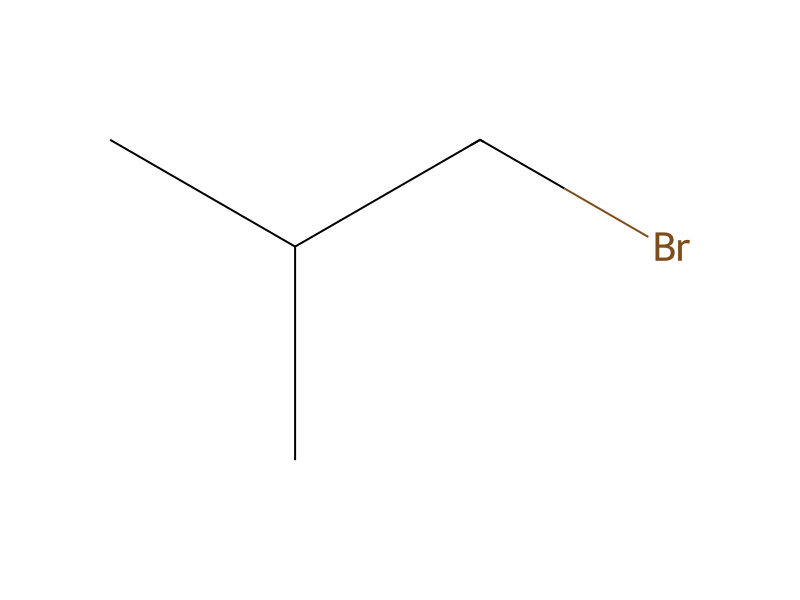
1-Bromo-2-methylpropane → HCID 14590574, compound
Reaction equation

[NH2:1][C:2]1[C:6]([C:7]#[N:8])=[CH:5][NH:4][N:3]=1.Br[CH2:10][CH:11]([CH3:13])[CH3:12].C(=O)([O-])[O-].[K+].[K+]>C(#N)C>[NH2:1][C:2]1[C:6]([C:7]#[N:8])=[CH:5][N:4]([CH2:10][CH:11]([CH3:13])[CH3:12])[N:3]=1Participants
Reactant 3


Product 1

Reagents, catalysts & solvents 1

Conditions
- Temperature
- 80 °C
Procedure
3-Amino-4-pyrazolecarbonitrile 1 (Aldrich, 24.0 g, 0.222 mole), 1-bromo-2-methyl-propane (Lancaster, 36.48 g, 0.266 mole) and anhydrous potassium carbonate (Acros, 36.8 g, 0.266 mole) were suspended in 240 mL reagent grade acetonitrile and heated at 80° C. under nitrogen for 22 hours. LC/MS indicated 1 remained. Therefore, added an additional 3 mL (0.027 mole) 1-bromo-2-methylpropane and 4.25 g (0.031 mole) K2CO3. After 24 hours, the reaction was filtered and the filtrate concentrated in vacuo. The solid was stirred in 250 mL of water for 3.5 hours at room temp. The solid was filtered, washed with 50 mL diethyl ether, and dried to yield 16.28 g (45%) of a tan powder which was seen by 1H NMR to contain a mixture of 255 and 256 in approximately a 2:1 ratio. This mixture was used without further purification. Mixture of 255 and 256: mp 91.3-106; MS (ES+ calculated: 164.21; found: 165.28 M+H). HPLC (99% purity, retention times 6.920 and 7.086 minutes—Method B); 1H NMR (400 MHz, DMSO-d6) δ 8.05 and 7.51 (s, 1H), 6.50 and 5.49 (s, 2H), 3.68 (t, 2H), 2.05 (m, 1H), 0.82 and 0.81 (d, 6H).
Workup
- filtrationthe reaction was filtered
- concentrationthe filtrate concentrated in vacuo
- filtrationThe solid was filtered
- washwashed with 50 mL diethyl ether
- customdried
Sources & evidence
- ORD record
- ord-e96fbbeb071f48a3b782ecb736498ea7
- Source dataset
- uspto-grants-2013_01
- Patent number
- US08354414B2
Reaction notes
Loading…