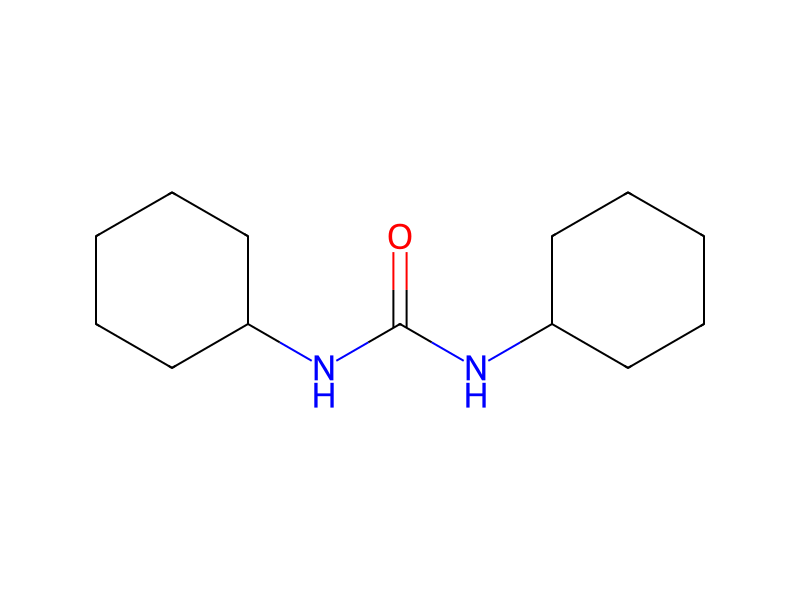
Dicyclohexylcarbodiimide → N,N'-Dicyclohexylurea
Reaction equation

C1C(C(O)=[O:8])=CC2C(OC3(C4C=CC(O)=CC=4OC4C=C(O)C=CC3=4)C=2C=1)=O.ON1C(=O)CCC1=O.[CH:37]1([N:43]=[C:44]=[N:45][CH:46]2[CH2:51][CH2:50][CH2:49][CH2:48][CH2:47]2)[CH2:42][CH2:41][CH2:40][CH2:39][CH2:38]1>CN(C)C=O>[C:44]([NH:43][CH:37]1[CH2:38][CH2:39][CH2:40][CH2:41][CH2:42]1)([NH:45][CH:46]1[CH2:51][CH2:50][CH2:49][CH2:48][CH2:47]1)=[O:8]Participants
Reactant 3



Product 1
Reagents, catalysts & solvents 1

Procedure
A synthetic aldehyde, Pro4-de novo CHO, was prepared as follows. To a stirred solution of 5-carboxyfluorescein (5-FAM) (190 mg, 0.51 mmol) in anhydrous N,N-dimethylformamide (DMF (5 mL) were added N-hydroxysuccinimide (NHS) (77 mg, 0.67 mmol) and 1,3-dicyclohexylcarbodiimide (DCC) (126 mg, 0.61 mmol). After approximately 5 minutes, a white solid (dicyclohexylurea) started forming. The reaction mixture was stirred overnight under nitrogen. Thin layer chromatography (TLC) (40:9:1 CH2Cl2—CH3OH-water) indicated complete disappearance of the starting material. The mixture was then filtered, and the filtrate was added dropwise to a stirred solution of ethylene diamine (46 mg, 0.77 mmol) in DMF (3 mL). A solid was obtained. As evident from TLC, the reaction was complete instantaneously. This reaction mixture was subsequently treated with glyoxylic acid NHS ester prepared below.
Sources & evidence
- ORD record
- ord-a5d04c78dd564e37bf6947c1812cc9a7
- Source dataset
- uspto-grants-2013_01
- Patent number
- US08357277B2
Reaction notes
Loading…