Methyl indole-6-carboxylate → Methyl indoline-6-carboxylate
Reaction equation

[BH3-]C#N.[Na+].[NH:5]1[C:13]2[C:8](=[CH:9][CH:10]=[C:11]([C:14]([O:16][CH3:17])=[O:15])[CH:12]=2)[CH:7]=[CH:6]1>C(O)(=O)C>[NH:5]1[C:13]2[C:8](=[CH:9][CH:10]=[C:11]([C:14]([O:16][CH3:17])=[O:15])[CH:12]=2)[CH2:7][CH2:6]1Participants
Reactant 2
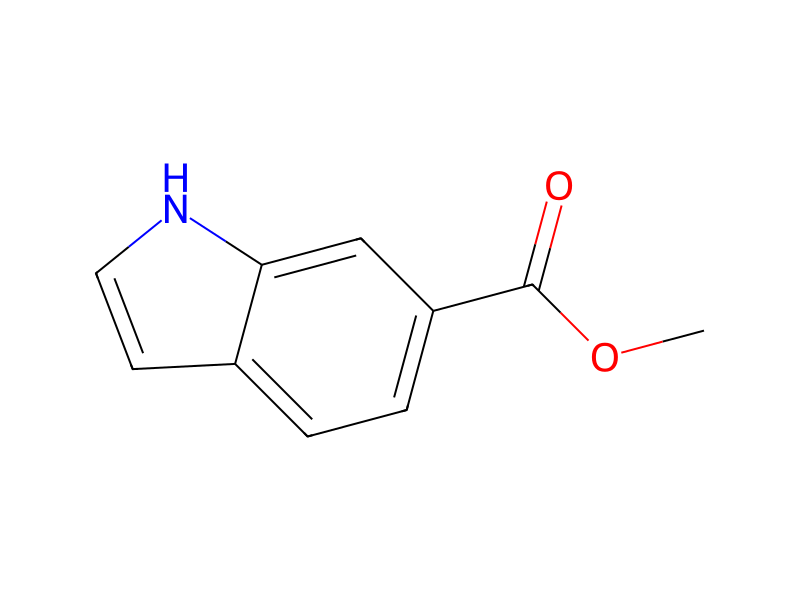

Product 1

Reagents, catalysts & solvents 1

Conditions
- Temperature
- 0 °C
Procedure
NaCNBH3 (11.49 g; 0.04 equiv.) was added at 0° C., over a period of 10 minutes, to a solution of methyl 1H-indole-6-carboxylate (8 g; 1 equiv.) in acetic acid (80 ml). The reaction mixture was stirred at 0° C. for 20 minutes and then warmed to room temperature and stirred for 1 hour at room temperature. When the conversion was complete, the acetic acid was distilled off under reduced pressure and the resulting residue was dissolved in dichloromethane. The resulting phases were separated. The organic phase was washed with 1N sodium hydroxide solution and dried over sodium sulfate. After removal of the solvent under reduced pressure, purification was carried out by column chromatography (silica gel, 10-15% ethyl acetate/hexane). Methyl indoline-6-carboxylate (6 g; 75%) was obtained in the form of a solid.
Workup
- temperaturewarmed to room temperature
- stirringstirred for 1 hour at room temperature
- distillationthe acetic acid was distilled off under reduced pressure
- dissolutionthe resulting residue was dissolved in dichloromethane
- customThe resulting phases were separated
- washThe organic phase was washed with 1N sodium hydroxide solution
- dry with materialdried over sodium sulfate
- customAfter removal of the solvent
- customunder reduced pressure, purification
Sources & evidence
- ORD record
- ord-2edd3167dc1e442990a2bf6d96214c6b
- Source dataset
- uspto-grants-2013_01
- Patent number
- US08357717B2
Reaction notes
Loading…