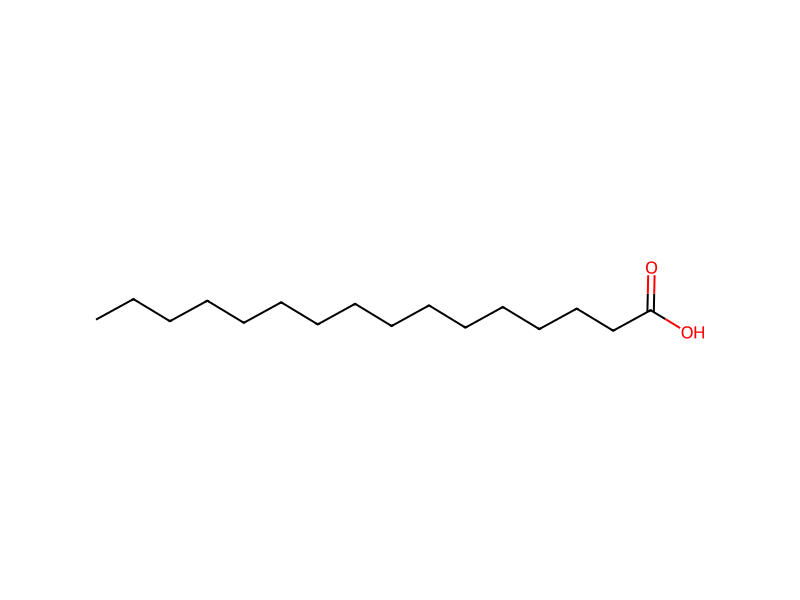
Stearic Acid → Palmitic Acid
Reaction equation

CC[CH2:3][CH2:4][CH2:5][CH2:6][CH2:7][CH2:8][CH2:9][CH2:10][CH2:11][CH2:12][CH2:13][CH2:14][CH2:15][CH2:16][CH2:17][C:18]([OH:20])=[O:19].CCCCCCCC/C=C\CCCCCCCC(O)=O>>[CH3:3][CH2:4][CH2:5][CH2:6][CH2:7][CH2:8][CH2:9][CH2:10][CH2:11][CH2:12][CH2:13][CH2:14][CH2:15][CH2:16][CH2:17][C:18]([OH:20])=[O:19]Participants
Reactant 2


Product 1
Procedure
Fatty acid methyl esters were tested for cold temperature performance as detailed above. The chart below shows the effect of adding long chain saturated fatty acids to C18:1 methyl ester (methyl octadecenoate). Pure C18:1 methyl ester is liquid at −20° C. but addition of C18:0 methyl octadecanoate) raises the observed pour point to as high as +5° C. with as little as 2% C18:0 present in the mixture; at 1% C18:0 the pour point of the mixture is 0° C. Similarly, C16 mixtures with C18:1 dramatically raises the pour point. A mixture of 9% (v/v) C16 methyl ester (methyl hexadecanoate) with 91% C18:1 was solid at −5° C. As little as 3% C16:0 resulted in a solid at −15° C. C14:0 methyl ester (methyl tetradecanoate) at concentrations as low as 1% resulted in a solid at −20° C., and 30% C14:0 was solid at −10° C. Mixtures with C12:0 (methyl dodecanoate) presented an interesting and unexpected result. At levels of C12 between 1% and 5% the mixtures were solid at −20° C., but between 6% and 20% C12 mixtures with C18:1 remained liquid at −20° C. Accordingly, the presence of C12:0 in a biodiesel at 6-20%; or more preferably at 6-10%, has surprising beneficial effects on cold flow properties. Thus, while the longer chain saturated FAMEs significantly raised the pour point of mixtures with C18:1, C14 had a much smaller effect and C12 had almost no effect at concentrations up to 20% (v/v).
Workup
- customat −20° C.
- customis 0° C
- additionA mixture of 9% (v/v)
- customat −5° C
Sources & evidence
- ORD record
- ord-2a38b15ff1ce41619f1638031e7669a9
- Source dataset
- uspto-grants-2013_01
- Patent number
- US08361173B2
Reaction notes
Loading…