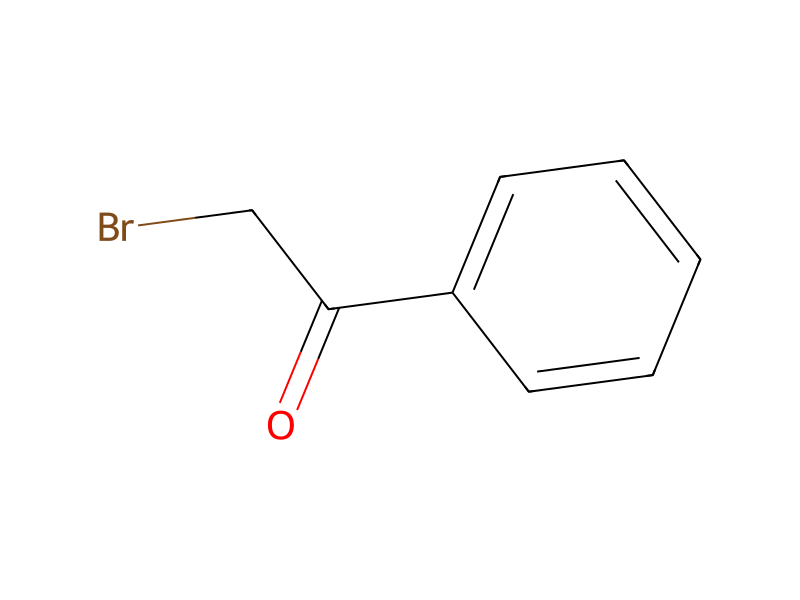
Phenacyl bromide → HCID 68982764, compound
Reaction equation

[N:1]1[CH:6]=[CH:5][CH:4]=[CH:3][C:2]=1[CH2:7][CH2:8][C:9]([NH2:11])=[O:10].Br[CH2:13][C:14]([C:16]1[CH:21]=[CH:20][CH:19]=[CH:18][CH:17]=1)=O>CC(C)=O>[C:16]1([C:14]2[C:7]([CH2:8][C:9]([NH2:11])=[O:10])=[C:2]3[N:1]([CH:13]=2)[CH:6]=[CH:5][CH:4]=[CH:3]3)[CH:21]=[CH:20][CH:19]=[CH:18][CH:17]=1Participants
Reactant 2

Product 1

Reagents, catalysts & solvents 1

Procedure
2-Pyridinepropaneamide (8.0 g, 53 mmol) was dissolved in warm acetone (500 mL). 2-Bromoacetophenone (12.0 g, 60 mmol) was added and the reaction mixture was heated under reflux overnight. After standing at room temperature for 2 days, the solvent was decanted from the tan precipitate, which was dissolved in ethanol and heated under reflux for 6 h. After standing overnight at ambient temperature, the ethanol was removed under reduced pressure to give a residue which was recrystallized from heptane (500 mL) to give 2-(2-phenyl-indolizin-1-yl)acetamide. 2-(2-Phenylindolizin-1-yl)acetamide (450 mg, 1.8 mmol) was suspended in ethyl ether. To the suspension was added lithium aluminum hydride (360 mg) and the reaction mixture was heated under reflux overnight under a nitrogen atmosphere. After cooling to room temperature, an aqueous solution of Rochelle salt was cautiously added with stirring until a solution was observed. The phases were separated and the aqueous phase was extracted 3 times with ether. The combined organic layers were extracted with 0.1 N HCl, and the aqueous layer was made basic with 2.5 N NaOH. The aqueous phase was extracted with methylene chloride three times and the organic phase was evaporated under reduced pressure to give crude product. The product was purified by chromatography on silica gel eluting with 5-11% methanol in methylene chloride containing 1% ammonium hydroxide. A 53% yield of the title compound was obtained, mp 212-214° C.
Workup
- temperaturethe reaction mixture was heated
- temperatureunder reflux overnight
- customthe solvent was decanted from the tan precipitate, which
- dissolutionwas dissolved in ethanol
- temperatureheated
- temperatureunder reflux for 6 h
- waitAfter standing overnight at ambient temperature
- customthe ethanol was removed under reduced pressure
- customto give a residue which
- customwas recrystallized from heptane (500 mL)
Sources & evidence
- ORD record
- ord-e66179ee9b59477db17f8ffa5bc9c721
- Source dataset
- uspto-grants-2009_10
- Patent number
- US07608626B2
Reaction notes
Loading…