Ethanol → 5-Fluoro-3-(3-oxycyclopentyl)indole
Reaction equation

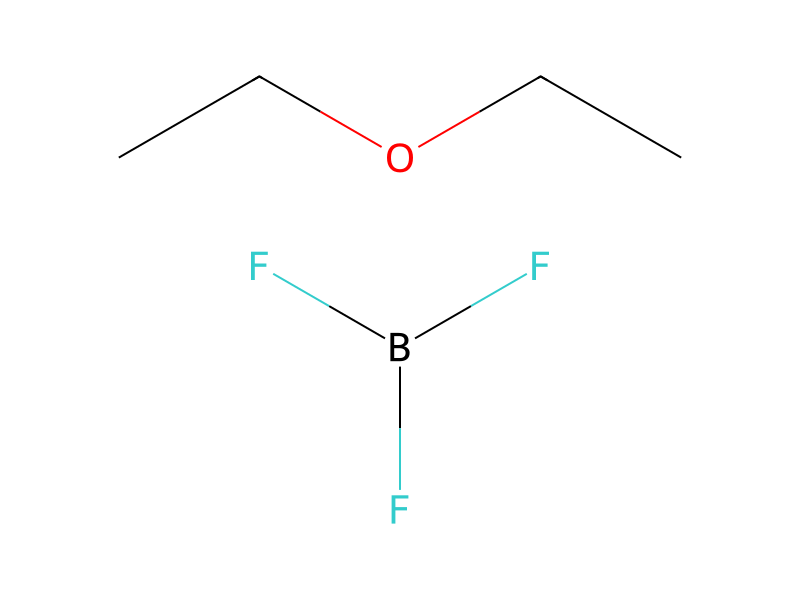
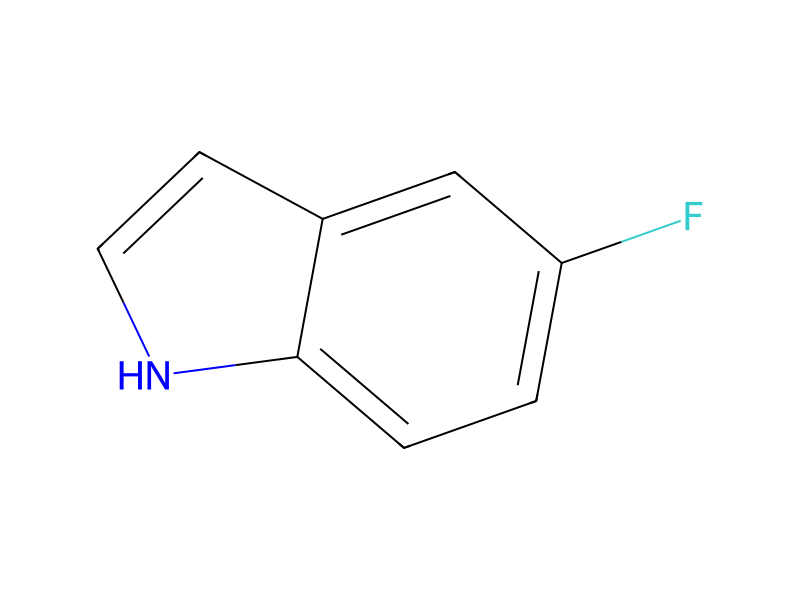
[F:1][C:2]1[CH:3]=[C:4]2[C:8](=[CH:9][CH:10]=1)[NH:7][CH:6]=[CH:5]2.[C:11]1(=[O:16])[CH2:15][CH2:14][CH:13]=[CH:12]1.B(F)(F)F.CCOCC.C(O)C>[N+](C)([O-])=O>[F:1][C:2]1[CH:3]=[C:4]2[C:8](=[CH:9][CH:10]=1)[NH:7][CH:6]=[C:5]2[CH:13]1[CH2:14][CH2:15][C:11](=[O:16])[CH2:12]1Participants
Reactant 4


Product 1

Reagents, catalysts & solvents 1

Conditions
- Temperature
- -20 °C
Procedure
A mixture of 5-fluoroindole (6.0 g, 44.4 mmol) and 2-cyclopenten-1-one (4.5 mL, 53.3 mmol) in nitromethane (22 mL) was cooled to −20° C. in a carbon tetrachloride-dry ice bath. A mixture of boron trifluoride etherate (1.6 mL, 11.1 mmol) and ethanol (2.2 mL, 43 mmol) was added dropwise from an addition funnel. The reaction mixture was stirred at −20° C. for 2 hours, then was quenched with 5% aqueous sodium bicarbonate solution (100 mL), and extracted with ethyl acetate (3×200 mL). The combined organic layers were washed with water (100 mL) and brine (100 mL), then were dried over anhydrous sodium sulfate, filtered and concentrated to give 9.5 g of the title compound. Trituration with ethyl acetate afforded 5.6 g (58%) of the title compound as a yellow solid. An analytical sample was recrystallized from ethyl acetate/methanol: mp 119–120° C.; MS (ESI) m/z 218 [M+H]+.
Workup
- additionwas added dropwise from an addition funnel
- customwas quenched with 5% aqueous sodium bicarbonate solution (100 mL)
- extractionextracted with ethyl acetate (3×200 mL)
- washThe combined organic layers were washed with water (100 mL) and brine (100 mL)
- dry with materialwere dried over anhydrous sodium sulfate
- filtrationfiltered
- concentrationconcentrated
Sources & evidence
- ORD record
- ord-9a9c3f1a54f245ab9749467552aa3f07
- Source dataset
- uspto-grants-2006_05
- Patent number
- US07041697B2
Reaction notes
Loading…