Sodium Hydroxide → 3,5-Dichloro-4-(5-trifluoromethyl-benzothiazol-2-ylsulfanyl)phenylamine
Reaction equation

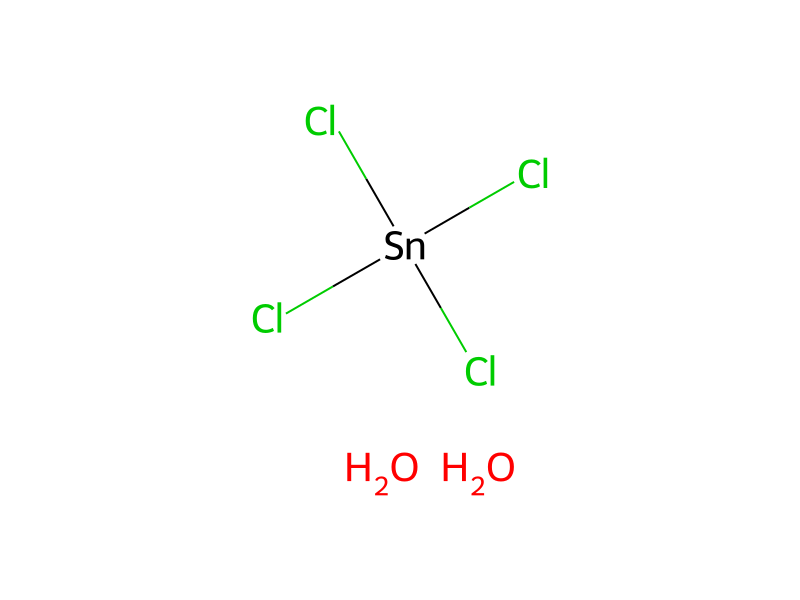
[Cl:1][C:2]1[CH:7]=[C:6]([N+:8]([O-])=O)[CH:5]=[C:4]([Cl:11])[C:3]=1[S:12][C:13]1[S:14][C:15]2[CH:21]=[CH:20][C:19]([C:22]([F:25])([F:24])[F:23])=[CH:18][C:16]=2[N:17]=1.O.O.[Sn](Cl)(Cl)(Cl)Cl.[OH-].[Na+]>CCOC(C)=O>[Cl:11][C:4]1[CH:5]=[C:6]([NH2:8])[CH:7]=[C:2]([Cl:1])[C:3]=1[S:12][C:13]1[S:14][C:15]2[CH:21]=[CH:20][C:19]([C:22]([F:25])([F:23])[F:24])=[CH:18][C:16]=2[N:17]=1Participants
5
Reactant 3


Product 1

Reagents, catalysts & solvents 1

Procedure
To a solution of 2-(2,6-dichloro-4-nitro-phenylsulfanyl)-5-trifluoromethyl-benzothiazole (258) (840 mg, 1.98 mmol) in EtOAc (20 mL) was added tin chloride dihydrate (Aldrich, 2.15 g, 9.52 mmol) and the resulting mixture was heated to reflux for 3 hours. After cooled to room temperature, to the mixture was added excess of 4N aqueous NaOH solution and the resulting mixture was stirred for 20 minutes. The mixture was filtered through Celite pad and washed with EtOAc. The organic layer was separated, washed twice with a brine solution, dried over Na2SO4, and concentrated under vacuum to give compound 270 (755 mg, 96%) product as a pale yellow solid, which was used in the next reaction without further purification.
Workup
- temperaturethe resulting mixture was heated
- temperatureto reflux for 3 hours
- filtrationThe mixture was filtered through Celite pad
- washwashed with EtOAc
- customThe organic layer was separated
- washwashed twice with a brine solution
- dry with materialdried over Na2SO4
- concentrationconcentrated under vacuum
Sources & evidence
- ORD record
- ord-1254bdd51c7a4bf4997045099d130dd6
- Source dataset
- uspto-grants-2006_05
- Patent number
- US07041691B1
Reaction notes
Loading…