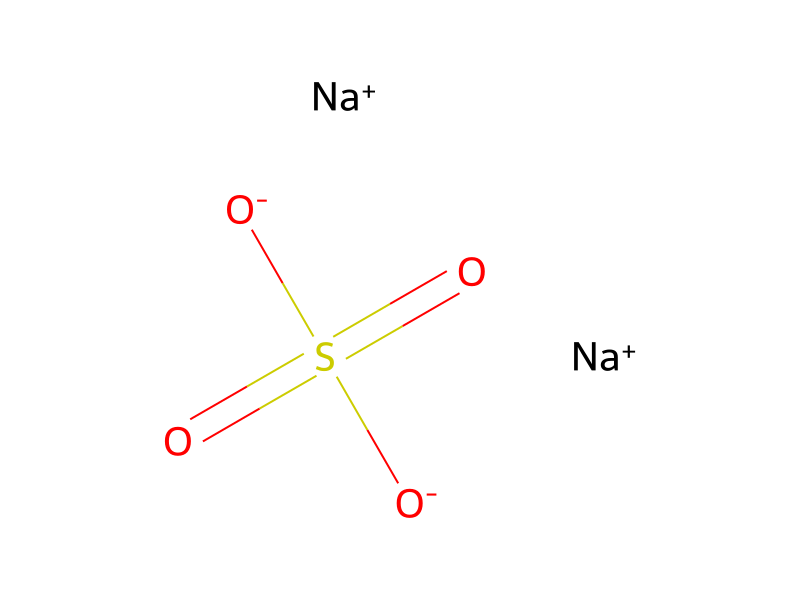
Sodium Sulfate → HCID 22136225, compound
Reaction equation

[O:1]([C:8]1[CH:15]=[CH:14][CH:13]=[C:12]([NH2:16])[C:9]=1[C:10]#[N:11])[C:2]1[CH:7]=[CH:6][CH:5]=[CH:4][CH:3]=1.[H-].[Al+3].[Li+].[H-].[H-].[H-].S([O-])([O-])(=O)=O.[Na+].[Na+]>O1CCCC1>[O:1]([C:8]1[CH:15]=[CH:14][CH:13]=[C:12]([NH2:16])[C:9]=1[CH2:10][NH2:11])[C:2]1[CH:3]=[CH:4][CH:5]=[CH:6][CH:7]=1Participants
Reactant 3


Product 1

Reagents, catalysts & solvents 1

Procedure
The product of example 2a above, 2-phenoxy-6-aminobenzonitrile, (1.5 g, 7.14 mmol) was dissolved in dry tetrahydrofuran (50 mL) and stirred under argon in a room temperature water bath. Lithium aluminum hydride (0.53 g, 14.0 mmol) was added in portions over 10 minutes. The reaction mixture was heated to 60° C. for 1 hour. The reaction mixture was cooled to room temperature and anhydrous sodium sulfate was added followed by quenching by the addition of a freshly prepared saturated solution of anhydrous sodium sulfate. The solvent was evaporated and the residue triturated with ethyl acetate, filtered and evaporated. Flash chromatography on silica gel eluted with 0–3% methanol in methylene chloride gave the title compound as a white amorphous solid. Recrystallization from carbon tetrachloride, hexane gave a white crystalline solid. mp 69–71° C.
Workup
- temperatureThe reaction mixture was heated to 60° C. for 1 hour
- temperatureThe reaction mixture was cooled to room temperature
- customby quenching by the addition of a freshly prepared saturated solution of anhydrous sodium sulfate
- customThe solvent was evaporated
- customthe residue triturated with ethyl acetate
- filtrationfiltered
- customevaporated
- washFlash chromatography on silica gel eluted with 0–3% methanol in methylene chloride
Sources & evidence
- ORD record
- ord-d0fd465b07f44f4cb9303ee0931784fc
- Source dataset
- uspto-grants-2006_05
- Patent number
- US07053099B1
Reaction notes
Loading…