Water → (3E)-4-Ethoxy-1,1,1-trifluoro-3-buten-2-one
Reaction equation

C1CN2C(=NCCC2)C1.[C:10](O)([C:12]([F:15])([F:14])[F:13])=[O:11].O.[CH:18]([O:20][CH2:21][CH3:22])=[CH2:19]>C1CCCCC1.CCCCC.CCCCCC.ClCCl>[CH3:22][CH2:21][O:20]/[CH:18]=[CH:19]/[C:10]([C:12]([F:15])([F:14])[F:13])=[O:11]Participants
Reactant 4


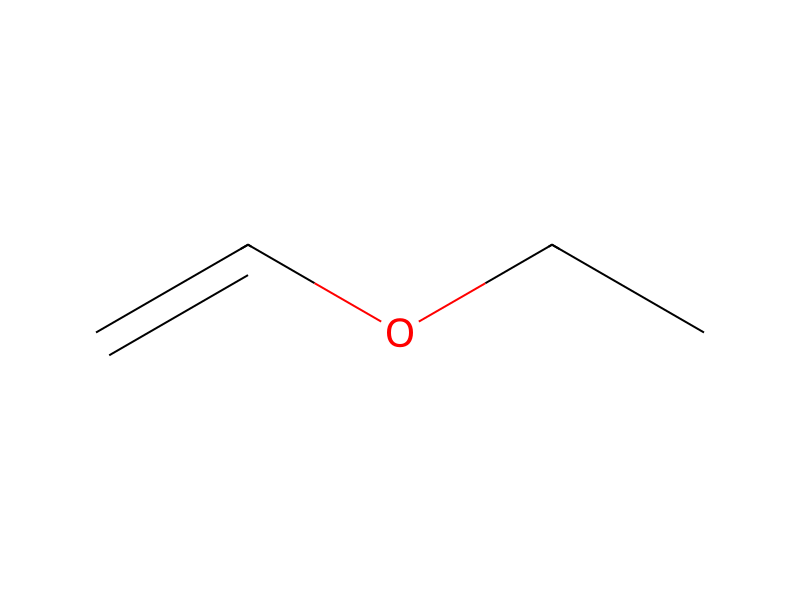

Product 1

Reagents, catalysts & solvents 4




Procedure
To begin with, DBN×TFA was prepared in a 250 ml 3-neck flask with a water-cooled condenser. For this purpose, dichloromethane and DBN were added to the flask, and TFA was added dropwise with stirring. Since the reaction is strongly exothermic, the flask was cooled in a water bath to prevent excessive heating. Subsequently, ethyl vinyl ether was added, and TFAH was added dropwise with stirring. The formulation turned yellow. Subsequently, stirring was continued for 1½ hours at room temperature, after which time a sample was taken for gas chromatographic (GC) analysis (sample was hydrolyzed). The ethyl vinyl ether had reacted completely. The dichloromethane was evaporated under vacuum at room temperature in a rotary evaporator, and the remaining solution was divided into partial volumes and extracted with different solvents, which formed two phases. Hexane, pentane, cyclohexane and 113 were used as two-phase extraction agents. The total yield of ETFBO isolated was 91%.
Workup
- temperaturecooled condenser
- additionwas added dropwise
- temperaturethe flask was cooled in a water bath
- additionTFAH was added dropwise
- stirringwith stirring
- stirringSubsequently, stirring
- waitwas continued for 1½ hours at room temperature
- customThe dichloromethane was evaporated under vacuum at room temperature in a rotary evaporator
- extractionextracted with different solvents, which
- customformed two phases
- extractionextraction agents
Sources & evidence
- ORD record
- ord-6379dfe218164f05a5d0c2d6aa938b9b
- Source dataset
- uspto-grants-2006_06
- Patent number
- US07057079B2
Reaction notes
Loading…