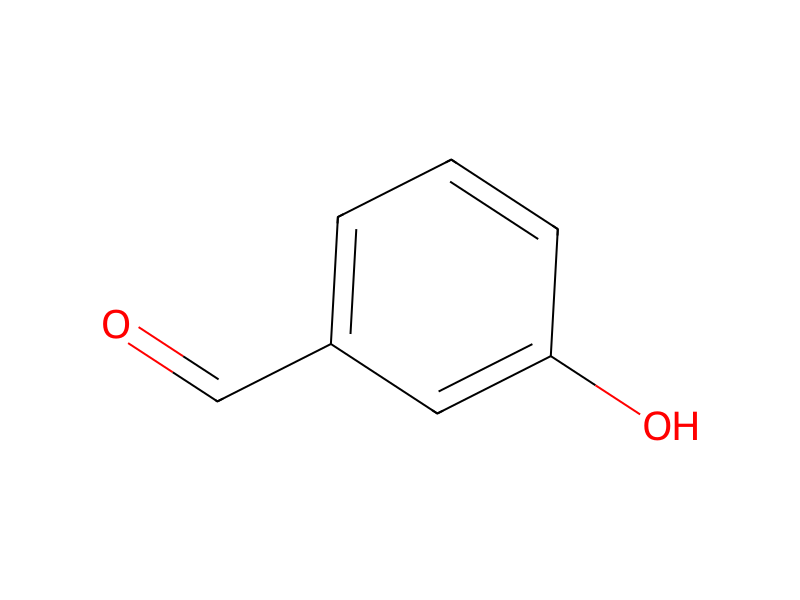
3-Hydroxybenzaldehyde → 3-(t-Butyldimethylsilyloxy)benzaldehyde
Reaction equation

[OH:1][C:2]1[CH:3]=[C:4]([CH:7]=[CH:8][CH:9]=1)[CH:5]=[O:6].[C:10]([Si:14](Cl)([CH3:16])[CH3:15])([CH3:13])([CH3:12])[CH3:11].N1C=CN=C1>ClCCl>[C:10]([Si:14]([CH3:16])([CH3:15])[O:1][C:2]1[CH:3]=[C:4]([CH:7]=[CH:8][CH:9]=1)[CH:5]=[O:6])([CH3:13])([CH3:12])[CH3:11]Participants
Reactant 3


Product 1

Reagents, catalysts & solvents 1

Procedure
3-Hydroxybenzaldehyde (5.14 g, 42.1 mmol) was added to a suspension of tert-butyl-dimethyl-silyl chloride (6.7 g, 44.4 mmol) and imidazole (3.03 g, 44.5 mmol) in dichloromethane (100 ml) under an atmosphere of nitrogen at room temperature. The reaction mixture was stirred at room temperature for 18 hours, and the mixture washed sequentially with 1 M hydrochloric acid (2-fold 50 ml) followed by a saturated aqueous solution of sodium hydrogen carbonate (50 ml). The organic phase was separated, dried over anhydrous magnesium sulphate and the solvent removed in vacuo. The residual yellow oil was passed through a plug of silica gel eluting with 1:1, by volume, dichloromethane:pentane giving 3-(tert-butyl-dimethyl-silanyloxy)-benzaldehyde (9.2 g) as a golden yellow oil.
Workup
- washthe mixture washed sequentially with 1 M hydrochloric acid (2-fold 50 ml)
- customThe organic phase was separated
- dry with materialdried over anhydrous magnesium sulphate
- customthe solvent removed in vacuo
Sources & evidence
- ORD record
- ord-81a12efc533c462da001e3ee70f4990f
- Source dataset
- uspto-grants-2006_06
- Patent number
- US07060717B2
Reaction notes
Loading…