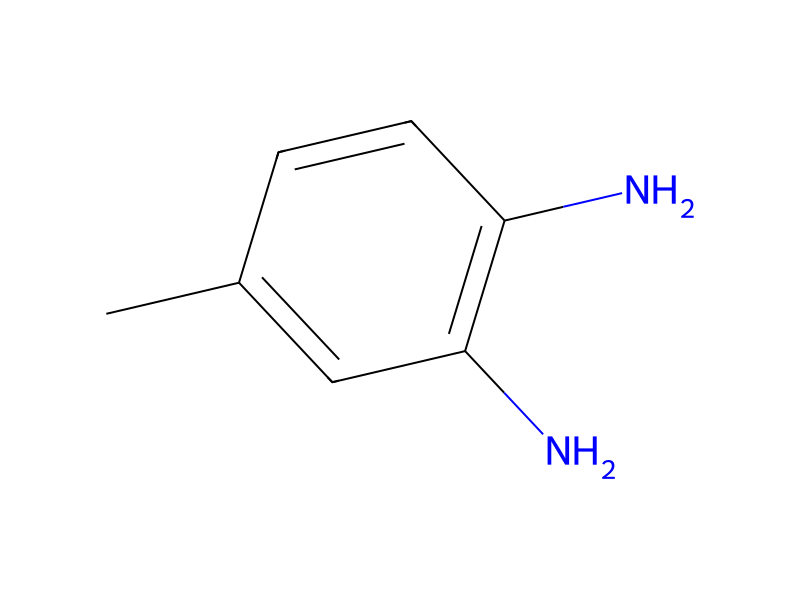
3,4-Diaminotoluene → HCID 178423472, compound
Reaction equation

[Cl:1][C:2]1[CH:3]=[C:4]2[C:8](=[CH:9][CH:10]=1)[NH:7][N:6]=[C:5]2[CH:11]=O.[NH2:13][C:14]1[CH:15]=[C:16]([CH3:21])[CH:17]=[CH:18][C:19]=1[NH2:20]>C1(C)C=CC=CC=1.C(O)C>[Cl:1][C:2]1[CH:3]=[C:4]2[C:8](=[CH:9][CH:10]=1)[NH:7][N:6]=[C:5]2[C:11]1[NH:20][C:19]2[CH:18]=[CH:17][C:16]([CH3:21])=[CH:15][C:14]=2[N:13]=1Participants
5
Reactant 2

Product 1

Reagents, catalysts & solvents 2


Conditions
- Temperature
- 100 °C
Procedure
A flask was charged with 5-chloro-1H-indazole-3-carbaldehyde (1.0 equivalent) and 3,4-diaminotoluene (1.0 equivalent) in toluene and ethanol (approximately 3:1). The flask was heated to 100° C. for 18 hours. The solvent was evaporated, and the residue purified by reverse phase HPLC to provide the desired product as a white solid. LC/MS (m/z) 283.1 (MH+), Rt 2.5 minutes.
Workup
- customThe solvent was evaporated
- customthe residue purified by reverse phase HPLC
Sources & evidence
- ORD record
- ord-3fdf0608cb4e4c9c9f40fa57e4465e2d
- Source dataset
- uspto-grants-2006_06
- Patent number
- US07064215B2
Reaction notes
Loading…