Hydrogen Peroxide → Sodium percarbonate
Reaction equation

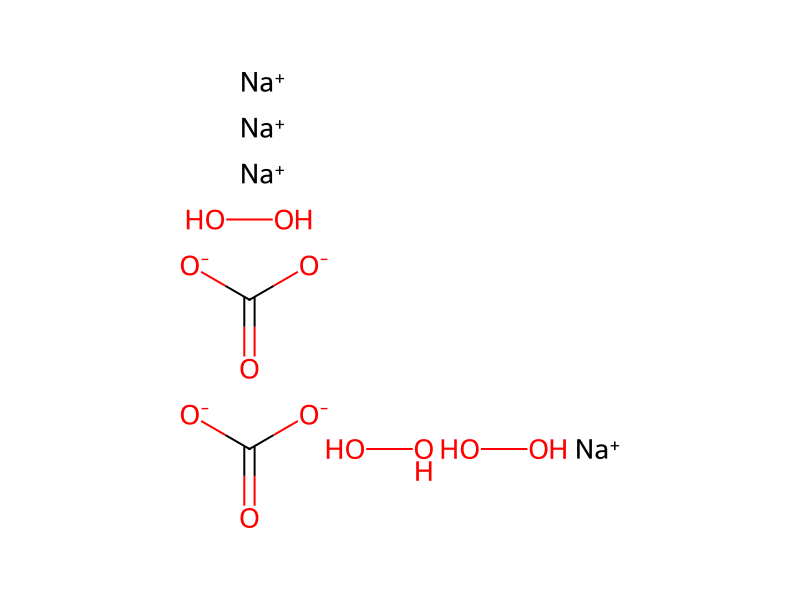
[C:1](=[O:4])([O-:3])[O-:2].[Na+:5].[Na+].[B:7]([O-:10])([O-])[O-:8].[Na+].[Na+].[Na+].[OH:14][OH:15]>>[C:1]([O-:4])([O-:3])=[O:2].[C:1]([O-:4])([O-:3])=[O:2].[OH:14][OH:15].[OH:14][OH:15].[OH:14][OH:15].[Na+:5].[Na+:5].[Na+:5].[Na+:5].[B:7]([O:10][O-:14])=[O:8].[Na+:5]Participants




Procedure
The anionic surface active agent can be added to either an aqueous solution of sodium carbonate or sodium borate, or to the aqueous hydrogen peroxide. Further, the order of mixing or addition is optional in this invention. More specifically, high specific volume sodium percarbonate or sodium perborate can be obtained in similar fashion (1) by adding the surface active agent to an aqueous solution of sodium carbonate or sodium borate and either (a) adding the resulting solution to aqueous hydrogen peroxide, or (b) adding aqueous hydrogen peroxide to the above-mentioned solution, or (2) by adding the surface active agent to aqueous hydrogen peroxide and either (a) adding the resulting solution to an aqueous solution of sodium carbonate or sodium borate, or (b) by adding an aqueous solution of sodium carbonate or sodium borate to the above-mentioned hydrogen peroxide solution. In this invention, 15 to 70 percent by weight aqueous solution of sodium carbonate and 10 to 100 percent by weight aqueous hydrogen peroxide are used. Alternatively, 1 to 70 percent by weight aqueous solution of sodium borate and 5 to 100 percent by weight aqueous hydrogen peroxide are used. When sodium carbonate or sodium borate is not entirely dissolved, the slurry liquid may be used. Furthermore, according to this invention, solid sodium carbonate or sodium borate itself can be added to aqueous hydrogen peroxide containing a surface active agent.
Workup
- additionFurther, the order of mixing
- additionaddition
Sources & evidence
- ORD record
- ord-2c3bdfba0dce4bab9c027d8f3c9d9bf6
- Source dataset
- uspto-grants-1978_01
- Patent number
- US04071462
Reaction notes
Loading…