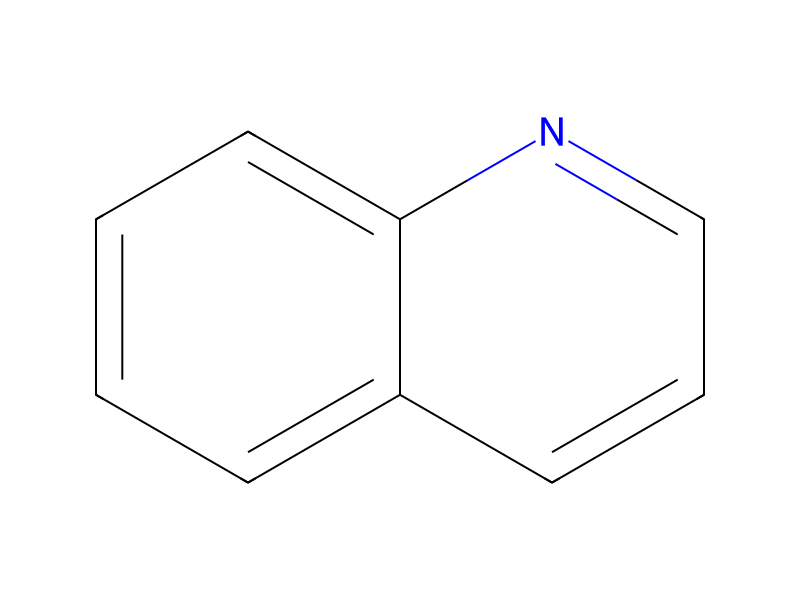
Quinoline → HCID 20372235, compound
Reaction equation

Br[C:2]1[CH:7]=[C:6]([F:8])[CH:5]=[CH:4][C:3]=1[C:9]([F:20])([F:19])[C:10]([F:18])([F:17])[C:11]1[CH:16]=[CH:15][CH:14]=[CH:13][CH:12]=1.[N:21]1C2C(=CC=CC=2)C=C[CH:22]=1>CN(C)C=O>[F:8][C:6]1[CH:5]=[CH:4][C:3]([C:9]([F:20])([F:19])[C:10]([C:11]2[CH:16]=[CH:15][CH:14]=[CH:13][C:12]=2[C:22]#[N:21])([F:18])[F:17])=[CH:2][CH:7]=1Participants
Reactant 2

Product 1

Reagents, catalysts & solvents 1

Procedure
A mixture of 8.5 g. (0.024 mole) of 2-bromo-4,α,α,α',α'-pentafluorobibenzyl, 6.4 g. of cuprous cyanide, 75 ml. of dry quinoline and 7.5 ml. of dry dimethylformamide is stirred and heated to refluxing for 34 hours. The precipitate is removed from the cooled mixture by filtration and washed with a mixture of benzene and ether. Solvents are evaporated from the filtrate under reduced pressure leaving the product as an oily black solid. Sublimation at 80° C. and 0.05 mm. yields light brown solid, m.p. 90°-93° C. Purification is effected by column chromatography on 300 g. of silica, the product being eluted with benzene-hexane (1:1). The fractions that show one spot of rf 0.85 on a fluorescent silica thin layer plate developed with benzene are combined. Evaporation of the solvent under reduced pressure leaves white crystals, m.p. 96.5°-97.5° C. A sample for analysis is sublimed.
Workup
- additionA mixture of 8.5 g
- temperatureheated
- temperatureto refluxing for 34 hours
- customThe precipitate is removed from the cooled mixture by filtration
- washwashed with a mixture of benzene and ether
- customSolvents are evaporated from the filtrate under reduced pressure
Sources & evidence
- ORD record
- ord-1415fb21d521436ca36de101d5894394
- Source dataset
- uspto-grants-1978_01
- Patent number
- US04071570
Reaction notes
Loading…