4-Bromoaniline → 1-(4-Bromophenyl)-2,5-diphenylpyrrole
Reaction equation

[C:1]1([C:7]#[C:8][C:9]#[C:10][C:11]2[CH:16]=[CH:15][CH:14]=[CH:13][CH:12]=2)[CH:6]=[CH:5][CH:4]=[CH:3][CH:2]=1.[Br:17][C:18]1[CH:24]=[CH:23][C:21]([NH2:22])=[CH:20][CH:19]=1>C(Cl)(Cl)Cl.[Cu]Cl>[Br:17][C:18]1[CH:24]=[CH:23][C:21]([N:22]2[C:7]([C:1]3[CH:6]=[CH:5][CH:4]=[CH:3][CH:2]=3)=[CH:8][CH:9]=[C:10]2[C:11]2[CH:12]=[CH:13][CH:14]=[CH:15][CH:16]=2)=[CH:20][CH:19]=1Participants
5
Reactant 2
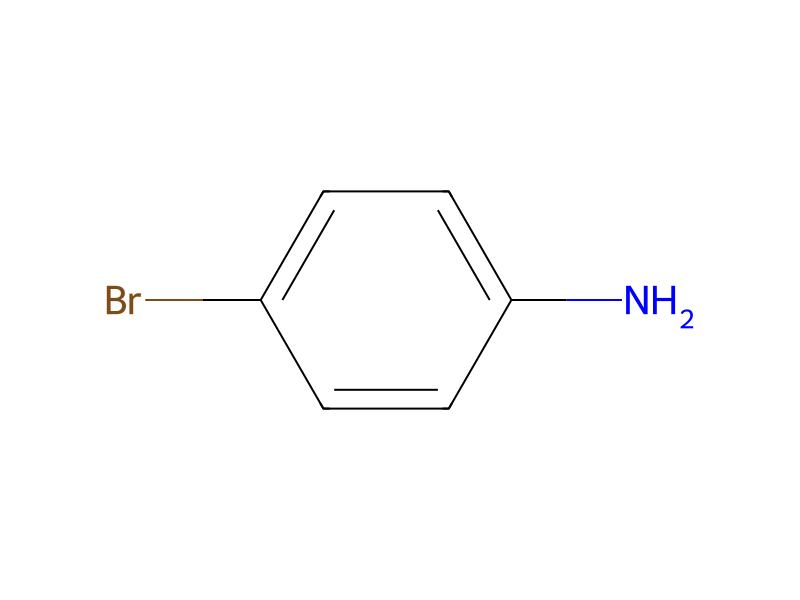

Product 1

Reagents, catalysts & solvents 2


Procedure
Under an argon atmosphere, 15 g (74 mmol) of 1,4-di-phenylbutadiyne, 12.76 g (74 mmol) of p-bromoaniline and 1.84 g (18 mmol) copper(I) chloride were put into 500 ml round-bottomed flask, and the resulting mixture was reacted at 150° C. for 5 hours while stirring. After the reaction was completed, the reaction mixture was cooled down to room temperature, dissolved in chloroform and then washed with 5% hydrochloric acid several times. The combined organic extract was washed with water several times and then dried with anhydrous magnesium sulfate. The solvent was removed to obtain solid, which was recrystallized from ethyl acetate to give 20.4 g (73.5%) white solid having a melting point of 218-219° C.
Workup
- customthe resulting mixture was reacted at 150° C. for 5 hours
- washwashed with 5% hydrochloric acid several times
- extractionThe combined organic extract
- washwas washed with water several times
- dry with materialdried with anhydrous magnesium sulfate
- customThe solvent was removed
- customto obtain solid, which
- customwas recrystallized from ethyl acetate
Sources & evidence
- ORD record
- ord-efd9c390287548859a18f29cf5d1b609
- Source dataset
- uspto-grants-2004_08
- Patent number
- US06780950B2
Reaction notes
Loading…