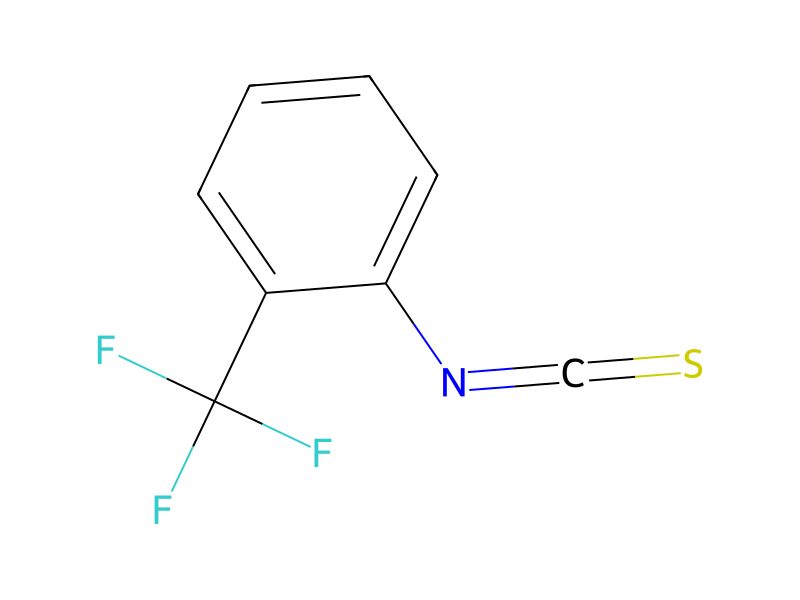
2-(Trifluoromethyl)phenyl isothiocyanate → HCID 23447744, compound
Reaction equation

NC(N)=S.[CH3:5][N:6]([CH3:19])[S:7]([C:10]1[C:15]([Cl:16])=[CH:14][CH:13]=[C:12]([NH2:17])[C:11]=1[OH:18])(=[O:9])=[O:8].[F:20][C:21]([F:32])([F:31])[C:22]1[CH:27]=[CH:26][CH:25]=[CH:24][C:23]=1[N:28]=[C:29]=[S:30]>>[Cl:16][C:15]1[CH:14]=[CH:13][C:12]([NH:17][C:29]([NH:28][C:23]2[CH:24]=[CH:25][CH:26]=[CH:27][C:22]=2[C:21]([F:20])([F:31])[F:32])=[S:30])=[C:11]([OH:18])[C:10]=1[S:7]([N:6]([CH3:19])[CH3:5])(=[O:9])=[O:8]Participants
4


Procedure
Following the general procedure for thiourea formation outlined in example 12, N,N-dimethyl-3-amino-6-chloro-2-hydroxybenzenesulfonamide (500 mg, 2 mmol) and 2-trifluoromethylphenylisothiocyanate (548 mg, 2 mmol) were coupled to form the desired thiourea (469 mg, 52%). EI-MS m/z 454.0 (M+).
Sources & evidence
- ORD record
- ord-5e379e2fcd7d4d909e4db8a95733c303
- Source dataset
- uspto-grants-2004_01
- Patent number
- US06680317B2
Reaction notes
Loading…