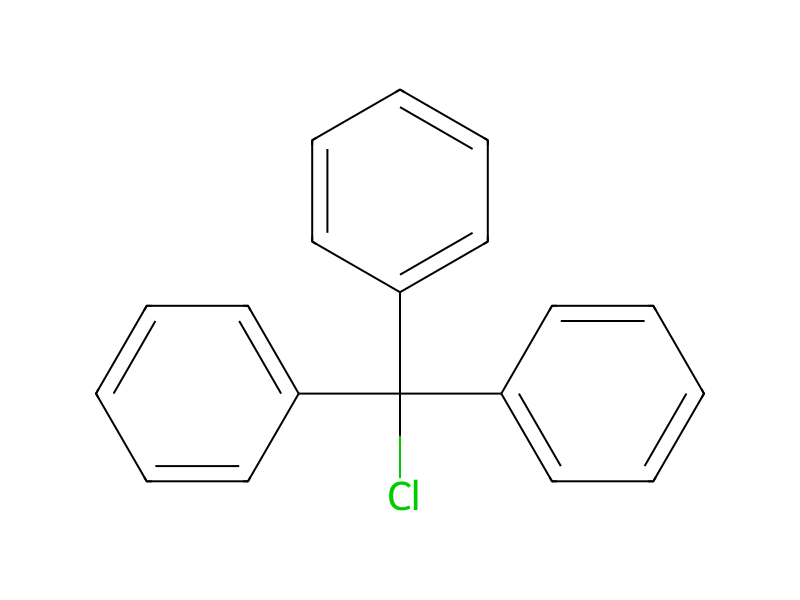
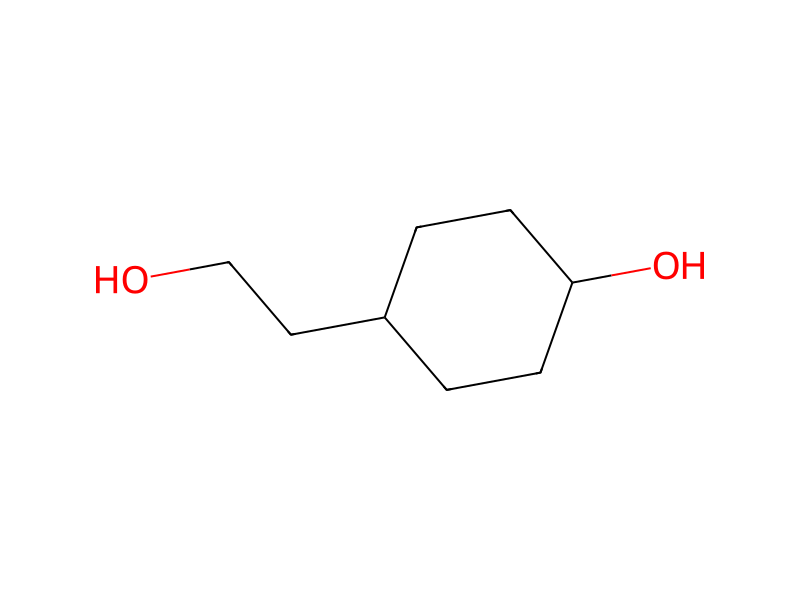
Trityl chloride → 4-[2-(Trityloxy)ethyl]cyclohexanol
Reaction equation

[OH:1][CH2:2][CH2:3][CH:4]1[CH2:9][CH2:8][CH:7]([OH:10])[CH2:6][CH2:5]1.[C:11]1([C:17](Cl)([C:24]2[CH:29]=[CH:28][CH:27]=[CH:26][CH:25]=2)[C:18]2[CH:23]=[CH:22][CH:21]=[CH:20][CH:19]=2)[CH:16]=[CH:15][CH:14]=[CH:13][CH:12]=1>N1C=CC=CC=1>[C:17]([O:1][CH2:2][CH2:3][CH:4]1[CH2:9][CH2:8][CH:7]([OH:10])[CH2:6][CH2:5]1)([C:11]1[CH:16]=[CH:15][CH:14]=[CH:13][CH:12]=1)([C:24]1[CH:25]=[CH:26][CH:27]=[CH:28][CH:29]=1)[C:18]1[CH:19]=[CH:20][CH:21]=[CH:22][CH:23]=1Participants
4
Reactant 2
Product 1

Reagents, catalysts & solvents 1

Conditions
- Temperature
- 0 °C
Procedure
4-(2-Hydroxyethyl)cyclohexanol (crude from the previous reaction) (1.88 g, 0.0130 mol) was dissolved in pyridine (20.00 mL) and was cooled at 0° C. To the reaction was added triphenylmethyl chloride (4.0 g, 0.014 mol) and this mixture was stirred at 0° C. for 2 hours and at 25° C. for 16 hours. The reaction was concentrated using a rotary evaporator and the concentrate was extracted with ethyl acetate. The organic extracts were washed with water, and saturated NaCl, then dried (MgSO4) and concentrated in vacuo. The concentrate was chromatographed on silica gel (30% EtOAc/hexanes) to give the trans isomer (1.98 g)
Workup
- concentrationThe reaction was concentrated
- customa rotary evaporator
- extractionthe concentrate was extracted with ethyl acetate
- washThe organic extracts were washed with water, and saturated NaCl
- dry with materialdried (MgSO4)
- concentrationconcentrated in vacuo
- customThe concentrate was chromatographed on silica gel (30% EtOAc/hexanes)
- customto give the trans isomer (1.98 g)
Sources & evidence
- ORD record
- ord-249f6090da514185b699694e99b4ee64
- Source dataset
- uspto-grants-2015_02
- Patent number
- US08946245B2
Reaction notes
Loading…